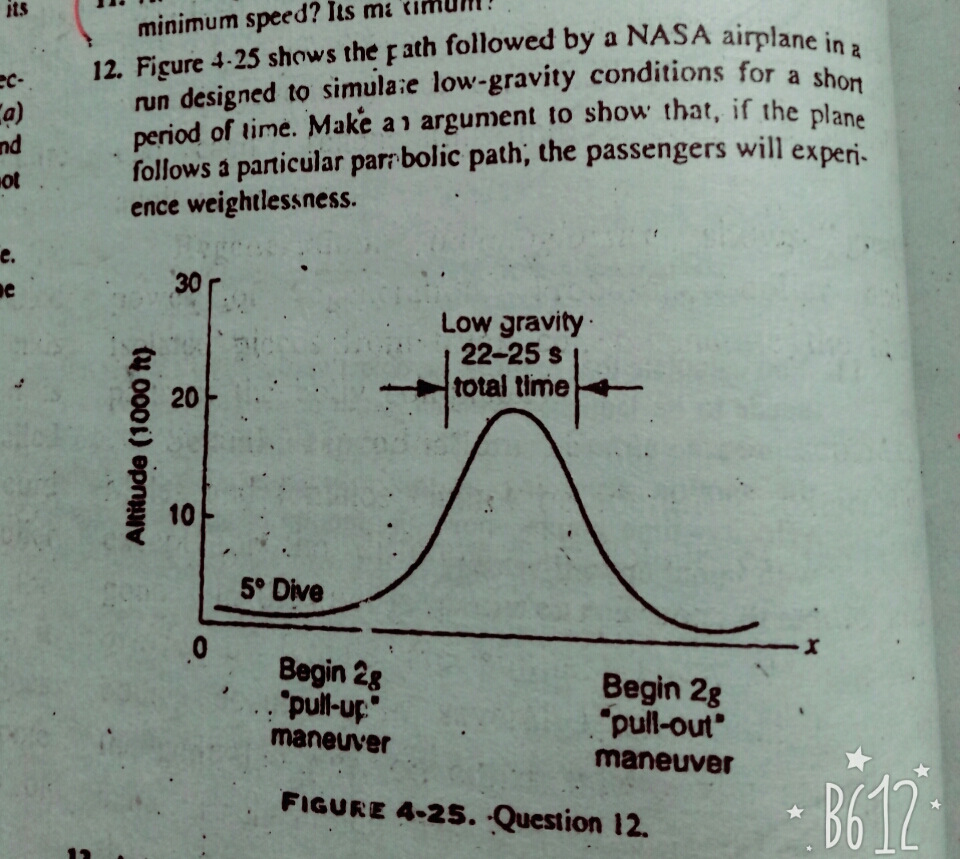
To understand how a passenger in a plane following a parabolic path can experience weightlessness, we need to delve into the principles of physics, particularly the concepts of gravity and acceleration. When a plane executes a parabolic flight path, it creates a unique environment that simulates the sensation of weightlessness, similar to what astronauts experience in space.
The Physics of Weightlessness
Weightlessness occurs when there are no contact forces acting on an object, which means that the object is in free fall. In the context of a plane flying in a parabolic trajectory, both the plane and its passengers are in a state of free fall. Let’s break this down further.
Understanding Free Fall
When an object is in free fall, it is falling under the influence of gravity alone, without any other forces acting on it. In a parabolic flight, the plane ascends and then descends in a curved path. During this descent, the plane and everything inside it, including the passengers, are accelerating downward at the same rate as gravity. This creates a sensation of weightlessness.
The Parabolic Path Explained
- Initial Ascent: The plane climbs upward, gaining altitude. At this point, passengers still feel their weight due to the upward acceleration of the plane.
- Peak of the Arc: At the top of the parabolic arc, the plane momentarily stops ascending before beginning its descent. Here, the forces acting on the passengers start to change.
- Descent Phase: As the plane descends, it accelerates downward. If the descent is steep enough, the passengers will experience a condition where the only force acting on them is gravity, leading to a sensation of weightlessness.
Illustrating the Concept
Imagine you are in an elevator. When the elevator starts to descend rapidly, you feel a brief moment of weightlessness as the elevator falls faster than the acceleration due to gravity. This is similar to what happens in a parabolic flight. The plane's descent creates a scenario where both the plane and the passengers are falling together, resulting in the absence of normal force that we typically feel as weight.
Real-World Applications
This principle is not just theoretical; it has practical applications. NASA and other space agencies use parabolic flights to train astronauts. During these flights, they can conduct experiments and practice maneuvers in a microgravity environment, which is essential for preparing for missions in space.
Conclusion
In summary, when a plane follows a parabolic path, it allows both the aircraft and its passengers to experience free fall. This results in a temporary state of weightlessness, as the only force acting on the passengers is gravity. Understanding this phenomenon helps us appreciate the complexities of flight dynamics and the unique experiences of astronauts in space.