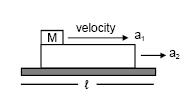
To solve the problem of the small block of mass m separating from the larger block of mass M, we need to analyze the forces acting on both blocks and the effects of friction. The key here is to understand how the frictional forces influence the motion of the blocks as they slide on the horizontal surface.
Understanding the Forces at Play
Initially, both blocks are moving together with an initial velocity v. As they slide, the friction between the larger block and the ground, as well as the friction between the two blocks, will dictate how they interact with each other. The coefficient of friction between the larger block and the ground is µ, while the friction between the two blocks is µ/2.
Frictional Forces
The frictional force acting on the larger block (M) due to the ground can be calculated using the formula:
Where N_M is the normal force on the larger block, which equals M * g (g is the acceleration due to gravity).
For the smaller block (m), the frictional force acting on it due to the larger block is:
- F_friction_m = (µ/2) * N_m
Here, N_m is the normal force on the smaller block, which is equal to m * g.
Acceleration of the Blocks
As the system starts moving, the larger block will experience a deceleration due to the frictional force acting against its motion. The acceleration (a_M) of the larger block can be expressed as:
For the smaller block, the frictional force will cause it to accelerate in the same direction as the larger block, but at a different rate. The acceleration (a_m) of the smaller block can be calculated as:
Relative Motion
To find the time before the smaller block separates from the larger block, we need to analyze their relative accelerations. The relative acceleration (a_rel) between the two blocks is given by:
Substituting the expressions for a_M and a_m, we get:
- a_rel = - (µ * g) / M - (µ/2 * g) / m
Time Until Separation
Initially, both blocks are moving with the same velocity v. The smaller block will start to lag behind due to the difference in their accelerations. The time (t) until the smaller block separates can be found using the equation of motion:
- distance = initial velocity * time + (1/2) * acceleration * time²
In this case, the distance between the two blocks when they separate is equal to the length of the larger block (l). Setting up the equation:
- l = v * t + (1/2) * a_rel * t²
Substituting for a_rel, we can solve this quadratic equation for t. The solution will yield the time elapsed before the smaller block separates from the larger block.
Final Thoughts
By carefully analyzing the forces and accelerations involved, we can determine the time it takes for the smaller block to separate from the larger block. This problem illustrates the importance of understanding friction and relative motion in dynamics, providing a practical application of Newton's laws of motion.