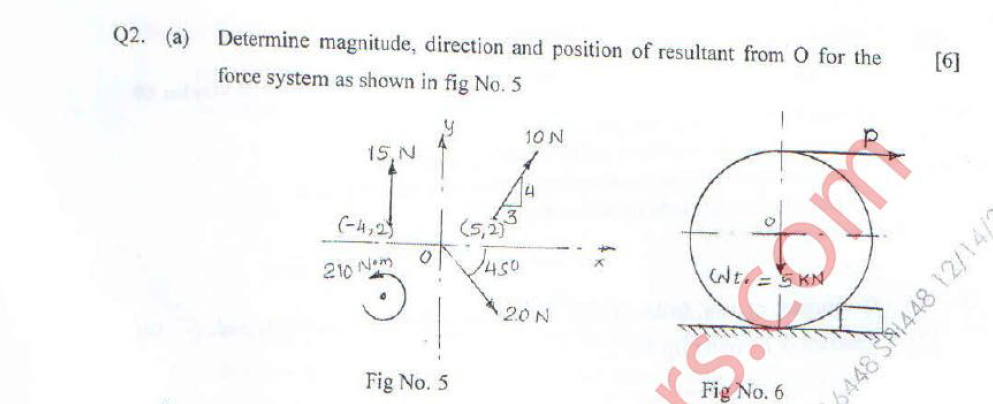
To determine the magnitude, direction, and position of the resultant force from point O for a given force system, we need to analyze the forces acting on the system. Although I can't see the figure you mentioned, I can guide you through the general process of solving such problems. Let's break it down step by step.
Understanding the Force System
First, we need to identify all the forces acting on the system. This includes their magnitudes, directions, and points of application. Forces can be represented as vectors, which have both magnitude and direction. If you have multiple forces, you will need to consider their components along the x and y axes.
Step 1: Resolve Forces into Components
For each force, resolve it into its horizontal (x) and vertical (y) components. This can be done using trigonometric functions:
- For a force F at an angle θ, the components are:
- Fx = F * cos(θ)
- Fy = F * sin(θ)
Step 2: Sum the Components
Once all forces are resolved into components, sum the x-components and y-components separately:
Step 3: Calculate the Resultant Force
The magnitude of the resultant force (R) can be found using the Pythagorean theorem:
Step 4: Determine the Direction
The direction of the resultant force can be calculated using the tangent function:
This angle θR is measured from the positive x-axis, and you may need to adjust it based on the quadrant in which the resultant lies.
Step 5: Find the Position of the Resultant
The position of the resultant force can be determined by calculating the moment about point O. The moment (M) due to a force is given by:
Where F is the force and d is the perpendicular distance from point O to the line of action of the force. The resultant moment about point O can be summed up for all forces, and the position of the resultant can be found by dividing the total moment by the magnitude of the resultant force:
Example Application
Imagine you have two forces acting at point O: 10 N at 30 degrees and 20 N at 120 degrees. You would first resolve these forces into their components, sum them, calculate the resultant magnitude and direction, and finally determine its position relative to point O using the moments. This systematic approach will yield the resultant force's characteristics effectively.
By following these steps, you can analyze any force system and determine the resultant force's magnitude, direction, and position from a specified point. If you have specific values or a diagram, feel free to share, and we can work through it together!