
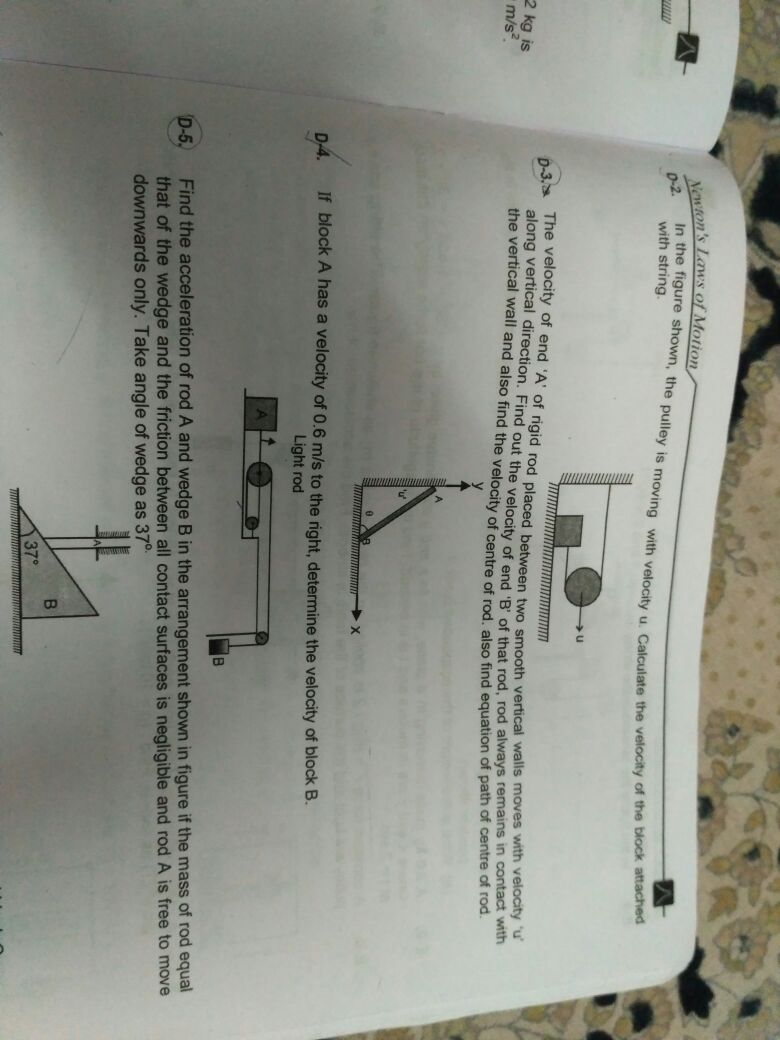
D3 and D5 answer ASAP a rigid rod is moving with velocity u in vertical direction

Rishik , 8 Years ago
Grade 12
 Mechanics> D3 and D5 answer ASAP a rigid rod is movi...
 1 Answers
When analyzing the motion of a rigid rod moving vertically with a velocity \( u \), we can consider several important aspects, including the forces acting on the rod, its center of mass, and the implications of its motion in a gravitational field. Let’s break this down step by step.
A rigid rod can be thought of as a straight line segment with a fixed length, and it can rotate about its center of mass or any other point. When this rod is moving vertically with a constant velocity \( u \), we need to consider the following:
In this scenario, we can apply the basic equations of motion. Since the rod is moving vertically, we can use the following kinematic equation to describe its position over time:
\( y(t) = y_0 + ut + \frac{1}{2}gt^2 \)
Here, \( y(t) \) is the vertical position of the rod at time \( t \), \( y_0 \) is the initial position, and \( g \) is the acceleration due to gravity (approximately \( 9.81 \, \text{m/s}^2 \)). Note that if the rod is moving upward, \( g \) will act in the opposite direction, effectively reducing the upward velocity over time.
As the rod moves upward, gravity will decelerate its motion. If the rod is initially moving upward, it will eventually reach a maximum height where its velocity becomes zero before starting to fall back down. The time taken to reach this maximum height can be calculated using:
\( t_{max} = \frac{u}{g} \)
After reaching the maximum height, the rod will begin to descend, accelerating downwards due to gravity.
Let’s consider a specific example. Imagine a rigid rod of length 2 meters and mass 5 kg is moving upward with a velocity of 10 m/s. The forces acting on it are:
Using the equations of motion, we can find the maximum height the rod will reach before it starts to fall back down. The time to reach maximum height is:
\( t_{max} = \frac{10 \, \text{m/s}}{9.81 \, \text{m/s}^2} \approx 1.02 \, \text{s} \)
During this time, the rod will ascend to a height calculated by substituting \( t_{max} \) into the position equation:
\( y(t_{max}) = y_0 + 10 \times 1.02 - \frac{1}{2} \times 9.81 \times (1.02)^2 \approx y_0 + 10.2 - 5.1 \approx y_0 + 5.1 \, \text{m} \)
This example illustrates how the motion of a rigid rod in a vertical direction can be analyzed using basic principles of physics, considering both its initial velocity and the effects of gravity. Understanding these concepts is crucial for solving more complex problems in dynamics.
 Approved
Prepraring for the competition made easy just by live online class.

Full Live Access

Study Material

Live Doubts Solving

Daily Class Assignments

Three identical balls are placed on a frictionless
horizontal surface touching each other. They stick to
each other because of adhesive. Another ball of same
radius and mass m is placed over the void created by
the three balls. Find the forces applied by the balls
kept on the floor to each other if the system remains
in equilibrium.
Last Activity: 4 Months ago
A car loaded with water having total mass 1000 kg moves on a straight horizontal Road starting from rest under the action of a force of 100 Newton. The water spills throw a small hole in the bottom at a rate of 0.1 KG per second the velocity of cart after 300 seconds is nearly.
11
21
31
41
Last Activity: 4 Months ago
Last Activity: 3 Years ago
Last Activity: 3 Years ago
Last Activity: 3 Years ago