Grade 12Mechanics
Critical Thinking – Creative Exercise
Besieging a City
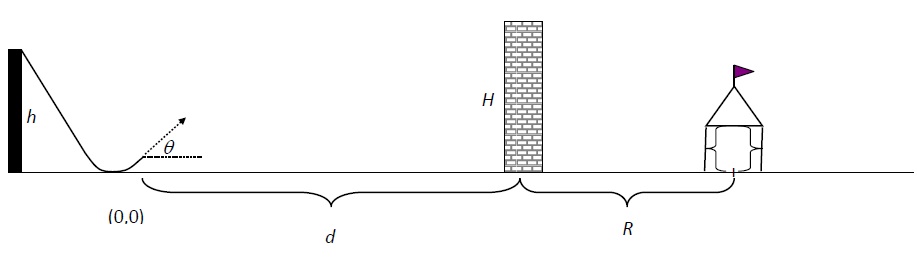
You are the head engineer of a medieval army, currently besieging a walled city (see figure). Orders have come from the commander directing you to construct an instrument of war, designed to attack the enemy from outside of the walls. Catapults and trebuchets have not been invented yet, so you decide to build a giant slide with a ramp that will launch a projectile with sufficient fury to clear the wall and land among the enemy king’s tents, instantly demoralizing his army and ensuring a swift victory. To keep your men and the slide safe, it must remain a distance 𝑑=100 m away from the wall, out of the range of enemy archers. The king has set his tents 𝑅=30 m beyond the wall, which is 𝐻=30 m high.
Your slide has two parameters that must be determined, the height (h) and the launch angle (θ). They must be chosen so that the projectile clears the wall and lands on the king. Assume the projectile leaves from ground level. Ignore friction and air resistance.
Choose the values h and θ such that your slide wins the war.
Before you invest resources constructing the slide you need to analyze the situation in order to be sure it will meet its requirements. What are the criteria for your weapon to be successful (there are two)? Does it meet them?
Preliminary considerations (do/answer them):
1) This is a complex problem. Often, it is helpful to break complex problems into pieces and then consider the pieces individually. Once you understand the pieces, you can try to connect them together. We can do such things to this problem. What are the pieces? What concepts are relevant in each piece?
2) Sometimes, it’s also helpful to first consider an easier problem. Here’s one for the current problem (work on it first): An object is launched from the ground at an angle θ. Find the speed necessary for it to land an arbitrary distance L away (ignore the wall).
3) Try to proceed systematically. What is the next complication to add to the problem? {Just consider this question. No need to include a response in your answer.}
To answer:
1) What are h and θ for your slide?
2) What is the speed, vo, with which your projectile enters the air?
3) What are the criteria for success? Show that your slide meets them.
Critical Thinking – Creative Exercise
Besieging a City
You are the head engineer of a medieval army, currently besieging a walled city (see figure). Orders have come from the commander directing you to construct an instrument of war, designed to attack the enemy from outside of the walls. Catapults and trebuchets have not been invented yet, so you decide to build a giant slide with a ramp that will launch a projectile with sufficient fury to clear the wall and land among the enemy king’s tents, instantly demoralizing his army and ensuring a swift victory. To keep your men and the slide safe, it must remain a distance 𝑑=100 m away from the wall, out of the range of enemy archers. The king has set his tents 𝑅=30 m beyond the wall, which is 𝐻=30 m high.
Your slide has two parameters that must be determined, the height (h) and the launch angle (θ). They must be chosen so that the projectile clears the wall and lands on the king. Assume the projectile leaves from ground level. Ignore friction and air resistance.
Choose the values h and θ such that your slide wins the war.
Before you invest resources constructing the slide you need to analyze the situation in order to be sure it will meet its requirements. What are the criteria for your weapon to be successful (there are two)? Does it meet them?
Preliminary considerations (do/answer them):
1) This is a complex problem. Often, it is helpful to break complex problems into pieces and then consider the pieces individually. Once you understand the pieces, you can try to connect them together. We can do such things to this problem. What are the pieces? What concepts are relevant in each piece?
2) Sometimes, it’s also helpful to first consider an easier problem. Here’s one for the current problem (work on it first): An object is launched from the ground at an angle θ. Find the speed necessary for it to land an arbitrary distance L away (ignore the wall).
3) Try to proceed systematically. What is the next complication to add to the problem? {Just consider this question. No need to include a response in your answer.}
To answer:
1) What are h and θ for your slide?
2) What is the speed, vo, with which your projectile enters the air?
3) What are the criteria for success? Show that your slide meets them.
Besieging a City
You are the head engineer of a medieval army, currently besieging a walled city (see figure). Orders have come from the commander directing you to construct an instrument of war, designed to attack the enemy from outside of the walls. Catapults and trebuchets have not been invented yet, so you decide to build a giant slide with a ramp that will launch a projectile with sufficient fury to clear the wall and land among the enemy king’s tents, instantly demoralizing his army and ensuring a swift victory. To keep your men and the slide safe, it must remain a distance 𝑑=100 m away from the wall, out of the range of enemy archers. The king has set his tents 𝑅=30 m beyond the wall, which is 𝐻=30 m high.
Your slide has two parameters that must be determined, the height (h) and the launch angle (θ). They must be chosen so that the projectile clears the wall and lands on the king. Assume the projectile leaves from ground level. Ignore friction and air resistance.
Choose the values h and θ such that your slide wins the war.
Before you invest resources constructing the slide you need to analyze the situation in order to be sure it will meet its requirements. What are the criteria for your weapon to be successful (there are two)? Does it meet them?
Preliminary considerations (do/answer them):
1) This is a complex problem. Often, it is helpful to break complex problems into pieces and then consider the pieces individually. Once you understand the pieces, you can try to connect them together. We can do such things to this problem. What are the pieces? What concepts are relevant in each piece?
2) Sometimes, it’s also helpful to first consider an easier problem. Here’s one for the current problem (work on it first): An object is launched from the ground at an angle θ. Find the speed necessary for it to land an arbitrary distance L away (ignore the wall).
3) Try to proceed systematically. What is the next complication to add to the problem? {Just consider this question. No need to include a response in your answer.}
To answer:
1) What are h and θ for your slide?
2) What is the speed, vo, with which your projectile enters the air?
3) What are the criteria for success? Show that your slide meets them.