Mechanics
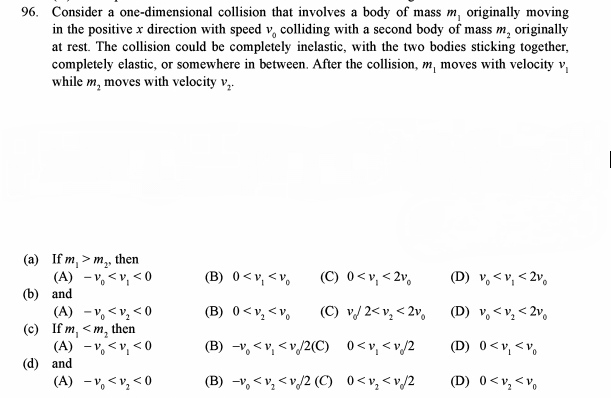
Consider a one-dimensional collision that involves a body of mass m1 originally moving
in the positive x direction with speed v0 colliding with a second body of mass m2 originally
at rest. The collision could be completely inelastic, with the two bodies sticking together,
completely elastic, or somewhere in between. After the collision, m1 moves with velocity v1
while m2 moves with velocity v2(a) If m1 > m2, then
(A) -v0
(B) 0
(C) 0
(D) v0 (b) and
(A) -v0
(B) 0
(C) v/ 2
(D) v0 (c) If m1
(A) -v0
(B) -Vo
(C) 0
(D) 0 (d) and
(A) -v0
(B) -v0
(C) 0
(D) 0
Consider a one-dimensional collision that involves a body of mass m1 originally moving
in the positive x direction with speed v0 colliding with a second body of mass m2 originally
at rest. The collision could be completely inelastic, with the two bodies sticking together,
completely elastic, or somewhere in between. After the collision, m1 moves with velocity v1
while m2 moves with velocity v2
in the positive x direction with speed v0 colliding with a second body of mass m2 originally
at rest. The collision could be completely inelastic, with the two bodies sticking together,
completely elastic, or somewhere in between. After the collision, m1 moves with velocity v1
while m2 moves with velocity v2
(a) If m1 > m2, then
(A) -v0
(B) 0
(C) 0
(D) v0
(A) -v0
(B) 0
(C) 0
(D) v0
(b) and
(A) -v0
(B) 0
(C) v/ 2
(D) v0
(A) -v0
(B) 0
(C) v/ 2
(D) v0
(c) If m1
(A) -v0
(B) -Vo
(C) 0
(D) 0
(A) -v0
(B) -Vo
(C) 0
(D) 0
(d) and
(A) -v0
(B) -v0
(C) 0
(D) 0
(A) -v0
(B) -v0
(C) 0
(D) 0