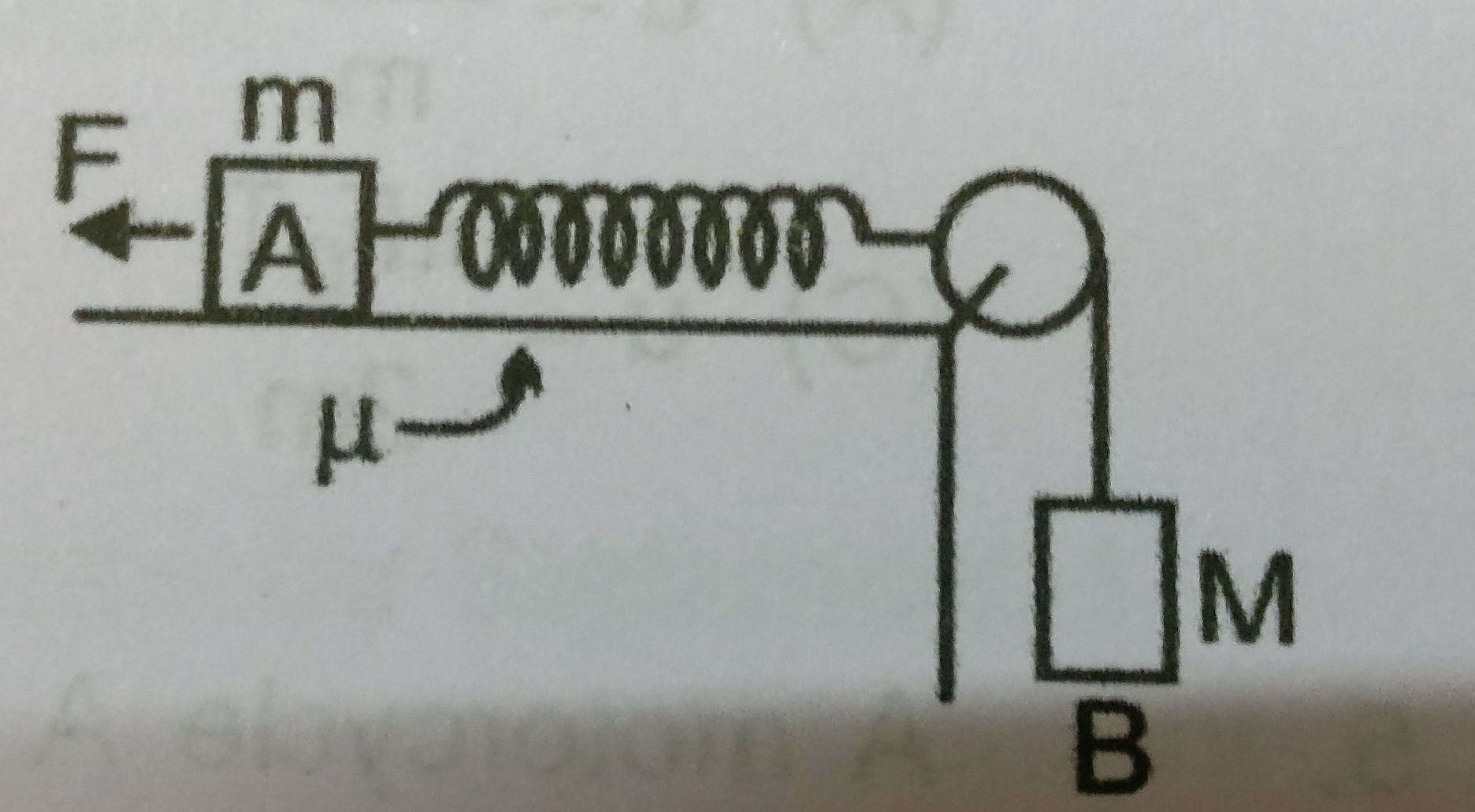
To determine the minimum value of mass M required to move block A to the right when a force F is applied to block A, we need to analyze the forces acting on both blocks and the effects of friction. Let's break this down step by step.
Understanding the Forces Involved
When the force F is applied to block A, it creates a tension in the spring connecting block A and block B. The frictional force acting on block A will oppose its motion, and we must consider the gravitational force acting on block B as well as the frictional force on the inclined plane.
Forces on Block A
For block A, the forces acting on it include:
- The applied force F (to the left)
- The tension T in the spring (to the right)
- The frictional force f_A, which is given by f_A = μ * N_A, where N_A is the normal force on block A.
The normal force N_A can be calculated based on the weight of block A and any additional forces acting perpendicular to the plane. If we assume block A is on a horizontal surface, then N_A = m * g, where g is the acceleration due to gravity.
Forces on Block B
For block B, the forces include:
- The gravitational force M * g acting downwards
- The tension T in the spring acting upwards
- The frictional force f_B acting on the inclined plane, which is f_B = μ * N_B, where N_B is the normal force on block B.
Assuming block B is on an inclined plane, the normal force N_B can be calculated as N_B = M * g * cos(θ), where θ is the angle of the incline.
Setting Up the Equations
To find the minimum mass M that allows block A to move to the right, we need to set up the equations of motion for both blocks. For block A to start moving to the right, the net force acting on it must be greater than zero:
F - T - f_A > 0
For block B, the condition for it to remain stationary (or just start moving) is:
T - M * g * sin(θ) - f_B = 0
Frictional Forces
The frictional forces can be expressed as:
- f_A = μ * m * g
- f_B = μ * M * g * cos(θ)
Combining the Equations
Substituting the expressions for the frictional forces into the equations, we can solve for T in terms of M:
From block A's equation:
T = F - μ * m * g
From block B's equation:
T = M * g * sin(θ) + μ * M * g * cos(θ)
Equating the Tensions
Setting the two expressions for T equal gives us:
F - μ * m * g = M * g * sin(θ) + μ * M * g * cos(θ)
Solving for M
Rearranging this equation to isolate M, we have:
M * (g * sin(θ) + μ * g * cos(θ)) = F - μ * m * g
Thus, we can express M as:
M = (F - μ * m * g) / (g * sin(θ) + μ * g * cos(θ))
Final Considerations
This equation gives us the minimum mass M required for block A to move to the right when the force F is applied. It’s important to ensure that the applied force is sufficient to overcome both the frictional forces and the gravitational component acting on block B. If the calculated M is negative or zero, it indicates that block A cannot move to the right under the given conditions.
In summary, by analyzing the forces acting on both blocks and setting up the equations of motion, we can find the minimum mass M necessary for block A to move rightward when subjected to an external force F.