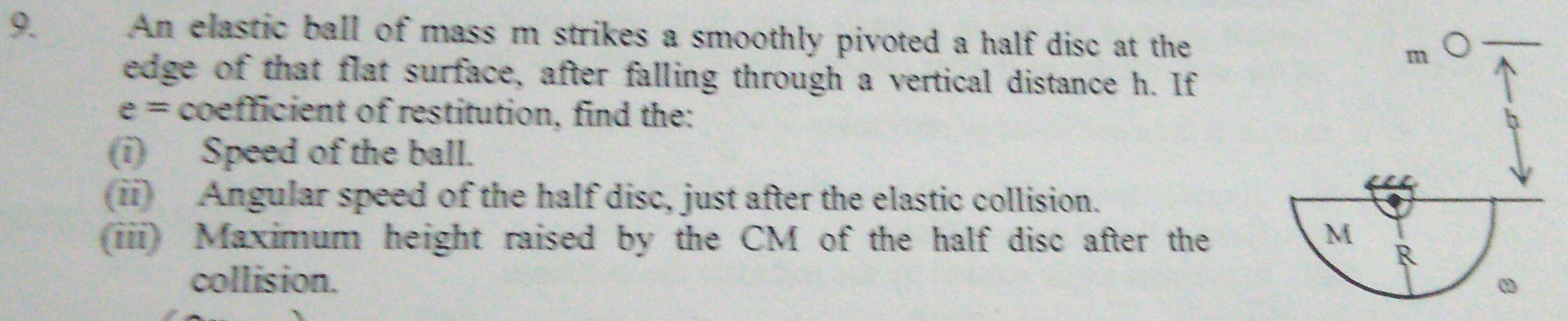
To determine the angular speed of the disc just after the elastic collision with the ball, we need to analyze the situation using principles of conservation of energy and angular momentum. Let's break this down step by step.
Understanding the Scenario
We have a ball of mass m that falls a vertical distance h before striking a half disc that is pivoted at its edge. The coefficient of restitution, e, describes how elastic the collision is. An elastic collision means that some kinetic energy is conserved, and we will use this to find the angular speed of the disc.
Step 1: Calculate the Velocity of the Ball Before Collision
When the ball falls through a height h, it converts its potential energy into kinetic energy. The potential energy at the height is given by:
- Potential Energy (PE) = mgh
At the moment just before the collision, all this potential energy has been converted into kinetic energy (KE), which is expressed as:
- Kinetic Energy (KE) = (1/2)mv²
Setting these equal gives us:
We can cancel m from both sides (assuming m is not zero) and solve for v:
- gh = (1/2)v²
- v² = 2gh
- v = √(2gh)
Step 2: Determine the Velocity of the Disc After Collision
When the ball strikes the edge of the disc, it exerts a force that causes the disc to rotate. The velocity of the ball just before the collision is v, and after the collision, the ball will have a new velocity v' given by:
Here, the negative sign indicates that the direction of the ball's velocity is reversed after the collision.
Step 3: Applying Conservation of Angular Momentum
Since the disc is pivoted and can rotate, we need to apply the principle of conservation of angular momentum about the pivot point. The initial angular momentum of the system before the collision is:
- Initial Angular Momentum (L_initial) = m * v * r
where r is the radius of the half disc. After the collision, the angular momentum of the system is:
- Final Angular Momentum (L_final) = I * ω
Here, I is the moment of inertia of the half disc about the pivot point, and ω is the angular speed we want to find. The moment of inertia of a half disc about its edge is:
- I = (1/2) * (1/2) * m * r² = (1/4) * m * r²
Step 4: Setting Up the Equation
By conservation of angular momentum, we have:
- m * v * r = (1/4) * m * r² * ω
We can cancel m and r (assuming r is not zero) from both sides:
Now, substituting for v from our earlier calculation:
Step 5: Solving for Angular Speed
Rearranging the equation to solve for ω gives:
This expression provides the angular speed of the disc just after the elastic collision. It shows how the height from which the ball falls and the radius of the disc influence the resulting angular speed.
Final Thoughts
In summary, the angular speed of the disc after the collision can be calculated using the height from which the ball fell and the radius of the disc. This problem beautifully illustrates the interplay between linear and angular motion, as well as the conservation laws that govern them.