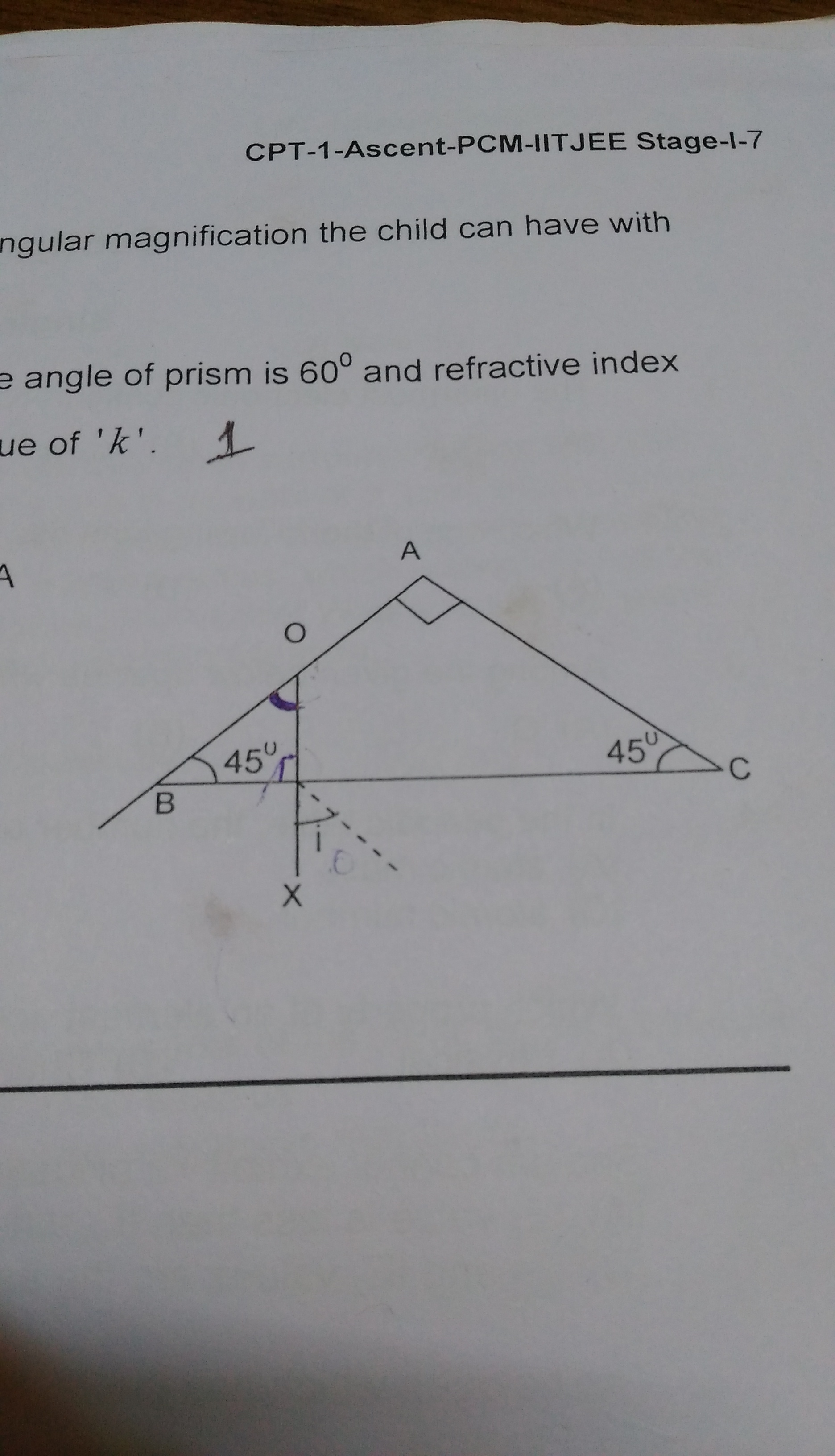
To solve the problem involving the right-angled prism ABC with a refractive index of √2, we need to analyze the behavior of light as it passes through the prism. The key here is to apply Snell's Law and the concept of total internal reflection. Let's break it down step by step.
Understanding the Geometry of the Prism
In a right-angled prism, one of the angles is 90 degrees. Let's denote the angles as follows:
- Angle A = 90 degrees
- Angle B = θ (the angle at point B)
- Angle C = 90 - θ (the angle at point C)
When a ray of light strikes face ABC, it will refract into the prism and then exit through face AC. The emergent ray grazing face AC indicates that it is at the critical angle for total internal reflection.
Applying Snell's Law
Snell's Law states that:
n1 * sin(i) = n2 * sin(r)
Where:
- n1 = refractive index of the medium from which the light is coming (air, which is approximately 1)
- n2 = refractive index of the prism (√2)
- i = angle of incidence
- r = angle of refraction
Finding the Critical Angle
For total internal reflection to occur at face AC, the angle of incidence at that face must be greater than the critical angle. The critical angle (C) can be calculated using:
sin(C) = n2 / n1
Substituting the values:
sin(C) = 1 / √2
This gives us:
C = 45 degrees
Calculating the Angle of Incidence
Now, when the ray exits the prism and grazes face AC, it means that the angle of incidence at face AC is equal to the critical angle (45 degrees). Since the sum of angles in a triangle is 180 degrees, we can find the angle of incidence (i) at face ABC.
Using the geometry of the prism, we know that:
i + r = 90 degrees
Since the ray grazes face AC, we have:
r = 45 degrees
Thus:
i + 45 = 90
Solving for i gives:
i = 90 - 45 = 45 degrees
Final Result
The angle of incidence (i) at face ABC, where the ray first strikes the prism, is therefore:
i = 45 degrees
This means that the light ray enters the prism at an angle of 45 degrees, which allows it to emerge grazing the face AC, confirming the conditions for total internal reflection. This analysis illustrates the interplay between geometry and optics in understanding light behavior in prisms.