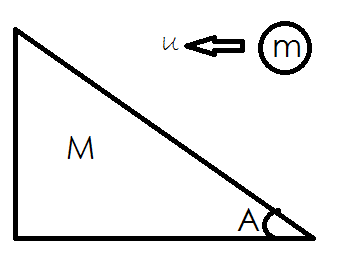
To solve the problem of a wedge with mass M and an inclined face colliding with a ball of mass m, we need to apply the principles of conservation of momentum. Since the collision is inelastic, we will consider the momentum before and after the collision to find the velocity of the wedge just after the impact.
Understanding the System
In this scenario, we have two main components: the wedge and the ball. The ball is moving horizontally with an initial speed u and strikes the inclined face of the wedge at an angle A. After the collision, the ball slides up the incline, and we want to determine the velocity of the wedge at that moment.
Applying Conservation of Momentum
Since there are no external horizontal forces acting on the system, the horizontal momentum before the collision must equal the horizontal momentum after the collision. We can break this down into steps:
- Initial Momentum: Before the collision, the total horizontal momentum is solely due to the ball, which is given by:
p_initial = m * u
- Final Momentum: After the collision, both the wedge and the ball will have horizontal velocities. Let v_w be the velocity of the wedge and v_b be the velocity of the ball after the collision. The total horizontal momentum after the collision can be expressed as:
p_final = M * v_w + m * v_b * cos(A)
Here, v_b * cos(A) represents the horizontal component of the ball's velocity after it slides up the incline.
Setting Up the Equation
By applying the conservation of momentum, we can set the initial momentum equal to the final momentum:
m * u = M * v_w + m * v_b * cos(A)
Finding the Ball's Velocity After Collision
To find v_b, we need to consider the vertical component of the ball's motion. Since the ball moves up the incline, we can express its velocity after the collision in terms of the angle A. The vertical component of the ball's velocity can be expressed as:
v_b * sin(A)
However, for the sake of this problem, we can assume that the ball's vertical motion does not affect the horizontal momentum directly. Therefore, we can simplify our calculations by focusing on the horizontal components.
Solving for the Wedge's Velocity
Rearranging our momentum equation gives us:
M * v_w = m * u - m * v_b * cos(A)
Now, if we assume that after the collision, the ball's horizontal velocity is reduced due to the wedge's motion, we can express v_b in terms of v_w. For simplicity, let’s assume that the ball continues moving horizontally with a reduced speed v_b = u - v_w.
Substituting this into our momentum equation:
M * v_w = m * u - m * (u - v_w) * cos(A)
Final Rearrangement
Now we can solve for v_w:
M * v_w + m * (u - v_w) * cos(A) = m * u
M * v_w + m * u * cos(A) - m * v_w * cos(A) = m * u
(M - m * cos(A)) * v_w = m * u - m * u * cos(A)
v_w = (m * u * (1 - cos(A))) / (M - m * cos(A))
Conclusion
The velocity of the wedge just after the collision can be expressed as:
v_w = (m * u * (1 - cos(A))) / (M - m * cos(A))
This equation allows you to calculate the wedge's velocity based on the masses involved and the angle of inclination. Remember, this analysis assumes no friction and an inelastic collision, which simplifies the calculations significantly.