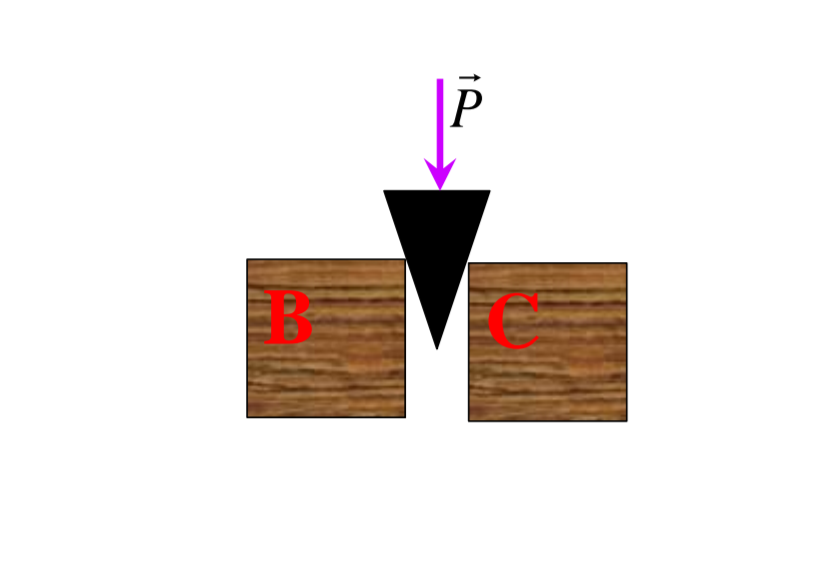
To determine the minimum force \( P \) required to start moving the wedge between the two blocks \( B \) and \( C \), we need to analyze the forces acting on the system in both scenarios: when both blocks are free to move and when block \( C \) is fixed to the horizontal surface. Let's break it down step by step.
Understanding the Wedge and Forces Involved
The wedge has a height of 4 inches and a base width of 1.5 inches. The angle of the wedge can be calculated using basic trigonometry, specifically the tangent function. The angle \( \theta \) can be found as follows:
Given:
- Height \( h = 4 \) in
- Base width \( b = 1.5 \) in
The angle \( \theta \) is given by:
\( \tan(\theta) = \frac{h}{b} = \frac{4}{1.5} \)
Calculating this gives:
\( \theta \approx 69.44^\circ \)
Scenario (a): Both Blocks Free to Move
In this case, both blocks \( B \) and \( C \) can move freely. The force \( P \) applied to the wedge will create a reaction force at the interface of the wedge and the blocks. The frictional force at the interface can be calculated using the coefficient of friction \( \mu \) given as 0.35.
The normal force \( N \) acting on the wedge from block \( B \) can be expressed as:
\( N = P \cdot \sin(\theta) \)
The frictional force \( F_f \) opposing the motion is:
\( F_f = \mu \cdot N = \mu \cdot (P \cdot \sin(\theta)) \)
For the wedge to start moving, the applied force \( P \) must overcome the total frictional force acting on both blocks. The total weight of the blocks is 100 lb each, so:
Total weight \( W = 100 \, \text{lb} + 100 \, \text{lb} = 200 \, \text{lb} \)
The frictional force acting on both blocks is:
\( F_{f, total} = 2 \cdot \mu \cdot W = 2 \cdot 0.35 \cdot 200 \, \text{lb} = 140 \, \text{lb} \)
Setting the forces equal for equilibrium:
\( P \cdot \sin(\theta) \cdot \mu = F_{f, total} \)
Substituting the values:
\( P \cdot \sin(69.44^\circ) \cdot 0.35 = 140 \, \text{lb} \)
Solving for \( P \):
\( P = \frac{140}{0.35 \cdot \sin(69.44^\circ)} \)
Calculating this gives:
\( P \approx 140 / 0.35 \cdot 0.933 = 140 / 0.32655 \approx 428.5 \, \text{lb} \)
Scenario (b): Block C Fixed
In this scenario, block \( C \) is fixed to the horizontal surface. This changes the dynamics because block \( C \) cannot move, which means the frictional force acting on block \( C \) is now static and only opposes the motion of block \( B \).
The frictional force acting on block \( C \) is:
\( F_f = \mu \cdot W_C = 0.35 \cdot 100 \, \text{lb} = 35 \, \text{lb} \)
Now, the force \( P \) must overcome this frictional force as well as the frictional force acting on block \( B \). The normal force on block \( B \) remains the same:
\( N = P \cdot \sin(\theta) \)
Thus, the frictional force on block \( B \) is:
\( F_{f,B} = \mu \cdot N = 0.35 \cdot (P \cdot \sin(\theta)) \)
Setting up the equilibrium equation for the fixed scenario:
\( P \cdot \sin(\theta) \cdot 0.35 + 35 = 0 \)
Solving for \( P \):
\( P \cdot \sin(69.44^\circ) \cdot 0.35 = 35 \)
\( P = \frac{35}{0.35 \cdot \sin(69.44^\circ)} \)
Calculating this gives:
\( P \approx 35 / 0.35 \cdot 0.933 \approx 35 / 0.32655 \approx 107.5 \, \text{lb} \)
Summary of Results
To summarize, the minimum force \( P \) required to start moving the wedge is:
- When both blocks are free to move: \( P \approx 428.5 \, \text{lb} \)
- When block \( C \) is fixed: \( P \approx 107.5 \, \text{lb} \)
This analysis illustrates how the constraints on the blocks significantly affect the force required to initiate movement. Understanding the interplay of forces and friction is crucial in solving problems involving wedges and static friction.