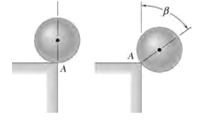
To tackle this problem, we need to analyze the motion of the sphere as it rotates around the corner A. The key here is to understand the forces acting on the sphere and how they influence its motion. Let's break this down step by step.
Understanding the Forces at Play
When the sphere is placed at corner A and given a slight clockwise motion, it experiences gravitational force acting downwards, a normal force from the corner acting perpendicular to the surface, and frictional force that prevents it from slipping off. The static friction is very high, which means the sphere can rotate without losing contact for a while.
Static Friction and Rotation
The static friction will act to keep the sphere in contact with the corner until the point of contact moves enough that the gravitational force can overcome this friction. As the sphere rotates, the point of contact shifts, and we need to find the angle at which the sphere loses contact.
Calculating the Angle of Rotation
Let’s denote the angle through which the sphere rotates as θ. The sphere will lose contact when the normal force becomes zero. At this point, the only forces acting on the sphere are its weight and the centripetal force required to keep it moving in a circular path around the corner.
Using the geometry of the situation, we can express the forces involved. The gravitational force acting on the sphere is given by:
- Weight (W) = mg, where m is the mass of the sphere and g is the acceleration due to gravity.
As the sphere rotates, the component of the gravitational force acting towards the center of the sphere provides the necessary centripetal force. The centripetal force required for circular motion is:
- Centripetal Force (F_c) = m(v^2/r), where v is the velocity of the center of the sphere.
At the point of losing contact, we can set up the equation:
Here, sin(θ) is the vertical component of the gravitational force acting downwards. Simplifying this gives us:
Finding the Angle θ
To find the angle θ, we can use the geometry of the sphere. The angle at which the sphere loses contact can be derived from the geometry of the situation. For a sphere of radius r, the angle θ can be approximated as:
Determining the Velocity of the Center of the Sphere
Next, we need to find the velocity of the center of the sphere at the moment it loses contact. We can substitute the expression for θ back into our earlier equation:
As the sphere rotates through angle θ, we can find the corresponding velocity using the relationship we established. If we assume a small angle approximation, we can simplify our calculations further. However, for a more accurate result, we would typically need to know the exact value of θ from the geometry of the corner and the sphere.
Final Expressions
Thus, the angle θ at which the sphere loses contact can be expressed as:
And the velocity of the center of the sphere when it loses contact can be expressed as:
In summary, by analyzing the forces and using the principles of circular motion, we can determine both the angle of rotation and the velocity of the sphere at the moment it loses contact with the corner. This approach combines physics concepts with geometry to provide a comprehensive understanding of the problem.


 through which the sphere will have rotated when it loses contact with the corner, (b) the corresponding velocity of the center of the sphere.