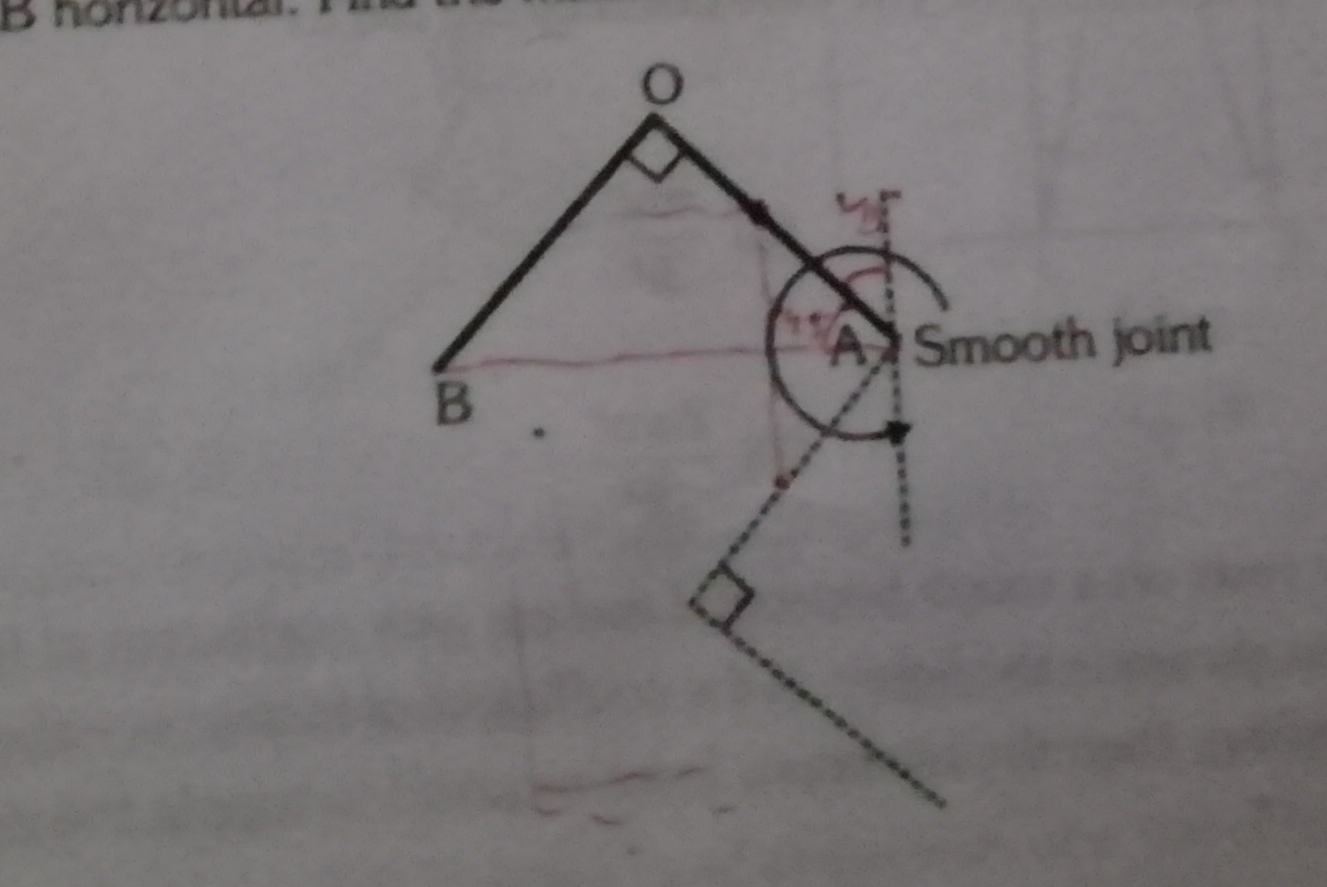
To determine the maximum kinetic energy of the "L" shaped rigid body AOB when it swings from a horizontal position, we can apply the principles of conservation of energy. The key here is to analyze the potential energy at the starting position and how it converts into kinetic energy as the body swings down.
Understanding the System
The body AOB is made up of two segments, AO and OB, each of length \( l \). When the body is released from rest with the segment AB horizontal, it has potential energy due to its height above the lowest point of the swing. As it swings down, this potential energy is converted into kinetic energy.
Calculating Initial Potential Energy
At the initial position, the center of mass of the "L" shaped body is located at a certain height. To find this height, we need to determine the position of the center of mass of the body. Since the body is uniform, the center of mass will be located at the midpoint of the shape.
- The center of mass of segment AO is at \( \left( \frac{l}{2}, 0 \right) \).
- The center of mass of segment OB is at \( \left( l, \frac{l}{2} \right) \).
To find the overall center of mass (CM), we can use the formula for the center of mass of a composite body:
\( x_{CM} = \frac{m_1 x_1 + m_2 x_2}{m_1 + m_2} \) and \( y_{CM} = \frac{m_1 y_1 + m_2 y_2}{m_1 + m_2} \)
Since both segments have the same mass \( m/2 \), we can simplify the calculations:
\( x_{CM} = \frac{\frac{m}{2} \cdot \frac{l}{2} + \frac{m}{2} \cdot l}{m} = \frac{3l}{4} \)
\( y_{CM} = \frac{\frac{m}{2} \cdot 0 + \frac{m}{2} \cdot \frac{l}{2}}{m} = \frac{l}{4} \)
Thus, the center of mass is located at \( \left( \frac{3l}{4}, \frac{l}{4} \right) \). When the body is horizontal, the height of the center of mass above the lowest point (which is when the body is vertical) is \( \frac{l}{4} \).
The potential energy (PE) at this height is given by:
\( PE = mgh = mg \cdot \frac{l}{4} = \frac{mgl}{4} \)
Converting Potential Energy to Kinetic Energy
As the body swings down to the vertical position, all of this potential energy will convert into kinetic energy (KE) at the lowest point of the swing. Therefore, at the lowest point, the kinetic energy will be equal to the initial potential energy:
\( KE_{max} = PE_{initial} = \frac{mgl}{4} \)
Final Result
Thus, the maximum kinetic energy of the "L" shaped rigid body AOB when it swings down to the vertical position is:
Maximum Kinetic Energy: \( KE_{max} = \frac{mgl}{4} \)
This result illustrates the conversion of potential energy into kinetic energy in a swinging system, showcasing the principles of energy conservation in a clear and practical manner.