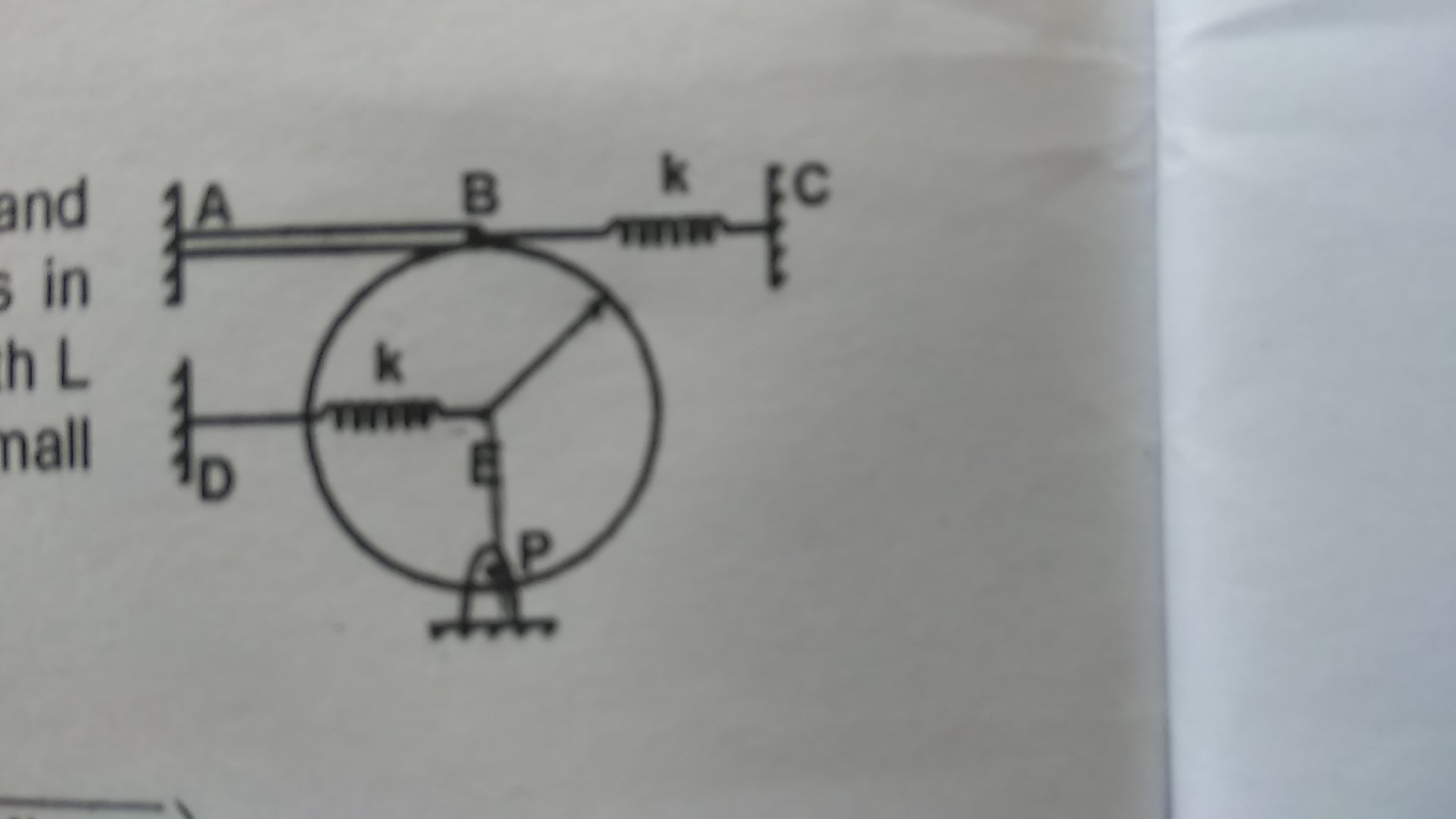
To determine the time period of angular oscillation of a uniform disc attached to springs in a gravity-free environment, we need to analyze the forces and torques acting on the disc. The setup involves a disc of mass \( m \) and radius \( r \) that is hinged at its lowest point, with two identical springs connected to it. The springs have a natural length \( l \), cross-sectional area \( a \), and Young's modulus \( Y \). Let's break down the problem step by step.
Understanding the System
The disc can oscillate about its hinge point when displaced from its equilibrium position. The restoring force provided by the springs will cause the disc to return to its original position, leading to oscillatory motion. The angular displacement from the equilibrium position can be denoted as \( \theta \).
Spring Force Calculation
When the disc is displaced by a small angle \( \theta \), the springs will stretch. The extension \( x \) of each spring can be approximated by the arc length, which is given by:
- Arc length \( s = r \theta \)
- Thus, the extension \( x \approx r \theta \)
The force exerted by each spring due to this extension can be calculated using Hooke's Law:
Force from one spring: \( F = kx \)
Where \( k \) is the spring constant, which can be derived from Young's modulus:
Spring constant: \( k = \frac{YA}{l} \)
Here, \( A \) is the cross-sectional area of the spring. Therefore, the total force from both springs when the disc is displaced is:
Total restoring force: \( F_{total} = 2k(r\theta) = 2 \left(\frac{YA}{l}\right)(r\theta) \)
Torque Calculation
The torque \( \tau \) about the hinge due to the restoring force is given by:
Torque: \( \tau = r \cdot F_{total} = r \cdot 2 \left(\frac{YA}{l}\right)(r\theta) = 2\frac{YA}{l}r^2\theta \)
Equation of Motion
The angular motion of the disc can be described by the equation:
Moment of inertia (I) of the disc: \( I = \frac{1}{2}mr^2 \)
Using Newton's second law for rotation, we have:
Equation: \( I \frac{d^2\theta}{dt^2} = -\tau \)
Substituting the expressions for \( I \) and \( \tau \):
Equation: \( \frac{1}{2}mr^2 \frac{d^2\theta}{dt^2} = -2\frac{YA}{l}r^2\theta \)
Dividing through by \( r^2 \) gives:
Final form: \( \frac{1}{2}m \frac{d^2\theta}{dt^2} + 2\frac{YA}{l}\theta = 0 \)
Finding the Time Period
This is a standard form of simple harmonic motion, where the angular frequency \( \omega \) is given by:
Angular frequency: \( \omega^2 = \frac{4YA}{ml} \)
The time period \( T \) of oscillation is related to the angular frequency by:
Time period: \( T = 2\pi \sqrt{\frac{I}{\tau}} \)
Substituting for \( I \) and \( \tau \), we find:
Final expression for time period: \( T = 2\pi \sqrt{\frac{m}{\frac{4YA}{l}}} = 2\pi \sqrt{\frac{ml}{4YA}} \)
Conclusion
Thus, the time period of angular oscillation of the disc in this system is given by:
Time Period: \( T = 2\pi \sqrt{\frac{ml}{4YA}} \)
This formula encapsulates how the mass of the disc, the properties of the springs, and the geometry of the system influence the oscillation period. Understanding these relationships is crucial for analyzing similar mechanical systems in physics.