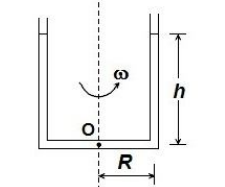
To find the angular velocity at which the pressure at point O in the U-tube becomes half of the atmospheric pressure, we can analyze the situation using the principles of fluid mechanics and centrifugal force. Let’s break it down step-by-step.
Understanding the Problem
The U-tube is filled with a liquid of density ρ and has its limbs in a vertical plane. When it is rotated about a vertical axis with an angular velocity ω, the pressure at any point within the liquid will change due to the effects of rotation. We need to determine the condition where the pressure at point O, which is located at the bottom of the U-tube, becomes half of atmospheric pressure (pa/2).
The Pressure Equation
In a rotating system, the pressure at a point can be given by the following equation:
Here:
- P is the pressure at point O.
- pa is the atmospheric pressure.
- ρ is the liquid density.
- g is the acceleration due to gravity.
- h is the height of the liquid column above point O.
- R is the radius of the U-tube limb from the axis of rotation.
- ω is the angular velocity.
Setting Up the Condition
We need to find the angular velocity ω such that the pressure P at point O equals half of the atmospheric pressure:
Substituting this into our pressure equation gives:
- pa / 2 = pa + ρgh - ρ(Rω²)
Rearranging this equation leads to:
- ρ(Rω²) = pa + ρgh - (pa / 2)
- ρ(Rω²) = (pa / 2) + ρgh
Solving for Angular Velocity
Now we can isolate ω:
- Rω² = (pa / (2ρ)) + h g
- ω² = [(pa / (2ρ)) + hg] / R
- ω = sqrt{[(pa / (2ρ)) + hg] / R}
Final Expression
Thus, the angular velocity ω at which the pressure at point O becomes half of the atmospheric pressure can be expressed as:
- ω = sqrt{(pa / (2ρR)) + (hg / R)}
Real-World Application
This principle has practical implications in various fields such as engineering and meteorology, where understanding fluid behavior under rotational forces is crucial. For example, in designing centrifuges or understanding atmospheric pressure changes in rotating systems, this knowledge can be applied effectively.
By analyzing the pressures exerted within the U-tube based on the centrifugal effects, we gain critical insights into fluid dynamics in rotational systems.