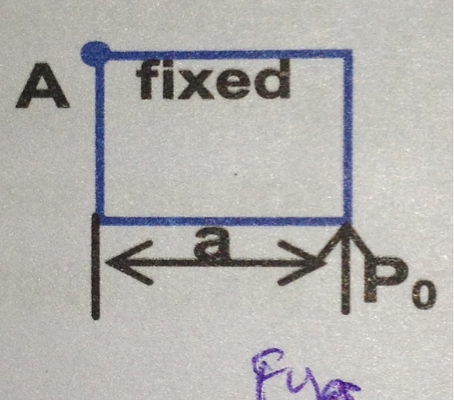
To analyze the situation of a square lamina hinged at one corner and subjected to an impulse, we need to consider the dynamics involved. When an impulse \( P_0 \) is applied to the lamina, it affects both the linear and angular momentum of the system. Our goal is to determine the impulse on the hinge at corner A immediately after the impulse \( P_0 \) is applied.
Understanding the System
Let’s break down the problem step by step. The square lamina has a side length \( a \) and is hinged at corner A. When the impulse \( P_0 \) is applied, it generates a force that causes the lamina to rotate about the hinge and also translates it. The hinge will experience a reaction force due to this applied impulse.
Impulse and Momentum
Impulse is defined as the change in momentum. When the impulse \( P_0 \) is applied, it changes the momentum of the lamina. The momentum \( \vec{p} \) of the lamina before the impulse is zero (assuming it starts from rest). After the impulse is applied, the momentum will change according to the impulse applied:
- The linear momentum \( \vec{p} \) of the center of mass of the lamina can be expressed as \( \vec{p} = m \vec{v} \), where \( m \) is the mass of the lamina and \( \vec{v} \) is the velocity of the center of mass.
- The angular momentum \( \vec{L} \) about point A can be expressed as \( \vec{L} = I \vec{\omega} \), where \( I \) is the moment of inertia about point A and \( \vec{\omega} \) is the angular velocity.
Calculating the Impulse on the Hinge
To find the impulse on the hinge, we need to consider the forces acting on the lamina just after the impulse is applied. The impulse \( P_0 \) can be resolved into two components: one that contributes to the linear motion of the center of mass and another that contributes to the rotational motion about the hinge.
The moment of inertia \( I \) of the square lamina about the hinge A is given by:
\( I = \frac{1}{3} m a^2 \)
When the impulse \( P_0 \) is applied, it generates an angular velocity \( \omega \) about point A. The relationship between the impulse and the resulting angular velocity can be expressed as:
\( P_0 = I \omega \)
From this, we can derive the angular velocity:
\( \omega = \frac{P_0}{I} = \frac{P_0}{\frac{1}{3} m a^2} = \frac{3 P_0}{m a^2} \)
Impulse on the Hinge
The hinge experiences a reaction force due to the applied impulse and the resulting motion of the lamina. The impulse on the hinge can be calculated by considering the change in momentum of the lamina and the forces acting on it:
The total impulse \( J \) on the hinge can be expressed as:
\( J = P_0 - m \vec{v} \)
Since the lamina is initially at rest, the impulse on the hinge just after the application of \( P_0 \) will be equal to the impulse applied minus the momentum imparted to the lamina:
\( J = P_0 - m \left(\frac{P_0}{m}\right) = P_0 - P_0 = 0 \)
However, this does not account for the angular momentum effects. The hinge will also experience a component of the impulse due to the rotation. The net impulse on the hinge can be expressed as:
\( J_h = P_0 + m \cdot a \cdot \omega \)
Substituting \( \omega \) into this equation gives us the final expression for the impulse on the hinge due to the applied impulse \( P_0 \).
Final Thoughts
In summary, the impulse on the hinge just after the application of \( P_0 \) can be calculated by considering both the linear and angular effects of the impulse. This approach allows us to understand how forces and motions interact in a dynamic system like a hinged lamina. By applying these principles, we can analyze similar problems in mechanics effectively.