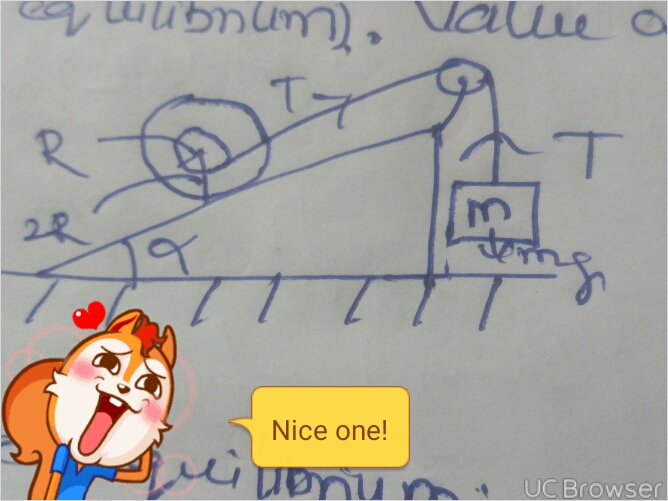
To determine the mass \( m \) of the weight hanging from the spool on the inclined plane, we need to analyze the forces and torques acting on the system. The setup involves a spool with a radius of \( 2R \) and a mass \( m \) that is connected to a thread wound around the spool. The inclined plane will also affect the forces due to gravity acting on the spool and the hanging weight.
Understanding the Forces Involved
First, let's identify the forces acting on the spool and the hanging weight:
- The gravitational force acting on the hanging mass \( m \), which is \( mg \), where \( g \) is the acceleration due to gravity.
- The tension \( T \) in the thread, which opposes the gravitational force on the hanging mass.
- The gravitational force acting on the spool, which can be decomposed into two components: one parallel to the incline and one perpendicular to it.
Setting Up the Equations
For the spool, we can analyze the torque caused by the tension in the thread. The torque \( \tau \) is given by:
Torque on the spool: \( \tau = T \cdot (2R) \)
According to Newton's second law for rotation, this torque is also equal to the moment of inertia \( I \) of the spool multiplied by its angular acceleration \( \alpha \):
Moment of inertia for a solid cylinder: \( I = \frac{1}{2} m R^2 \)
However, since the radius of the spool is \( 2R \), we need to adjust the moment of inertia accordingly:
Adjusted moment of inertia: \( I = \frac{1}{2} m (2R)^2 = 2mR^2 \)
Thus, we can write:
Equation for torque: \( T \cdot (2R) = 2mR^2 \cdot \alpha \)
Relating Linear and Angular Acceleration
The linear acceleration \( a \) of the mass \( m \) is related to the angular acceleration \( \alpha \) of the spool by the equation:
Relationship: \( a = \alpha \cdot (2R) \)
Substituting \( \alpha \) in terms of \( a \) into the torque equation gives us:
Substituted torque equation: \( T \cdot (2R) = 2mR^2 \cdot \frac{a}{2R} \)
Simplifying this, we find:
Final torque equation: \( T = \frac{ma}{2} \)
Applying Newton's Second Law
Now, we can apply Newton's second law to the hanging mass:
For the hanging mass: \( mg - T = ma \)
Substituting \( T \) from our earlier equation into this gives:
Substituted equation: \( mg - \frac{ma}{2} = ma \)
Rearranging this leads to:
Combined equation: \( mg = ma + \frac{ma}{2} = \frac{3ma}{2} \)
Solving for the Mass \( m \)
From the equation \( mg = \frac{3ma}{2} \), we can cancel \( m \) (assuming \( m \neq 0 \)):
Resulting equation: \( g = \frac{3a}{2} \)
Now, if we want to find the value of \( m \) in terms of the acceleration \( a \) and gravitational acceleration \( g \), we can express \( a \) as:
Acceleration: \( a = \frac{2g}{3} \)
Thus, the mass \( m \) can be determined based on the specific conditions of the problem, including the incline angle and the gravitational force acting on the spool. If you have specific values for the incline angle or other parameters, we can substitute those in to find a numerical value for \( m \).