Askiitians Tutor Team
Last Activity: 5 Months ago
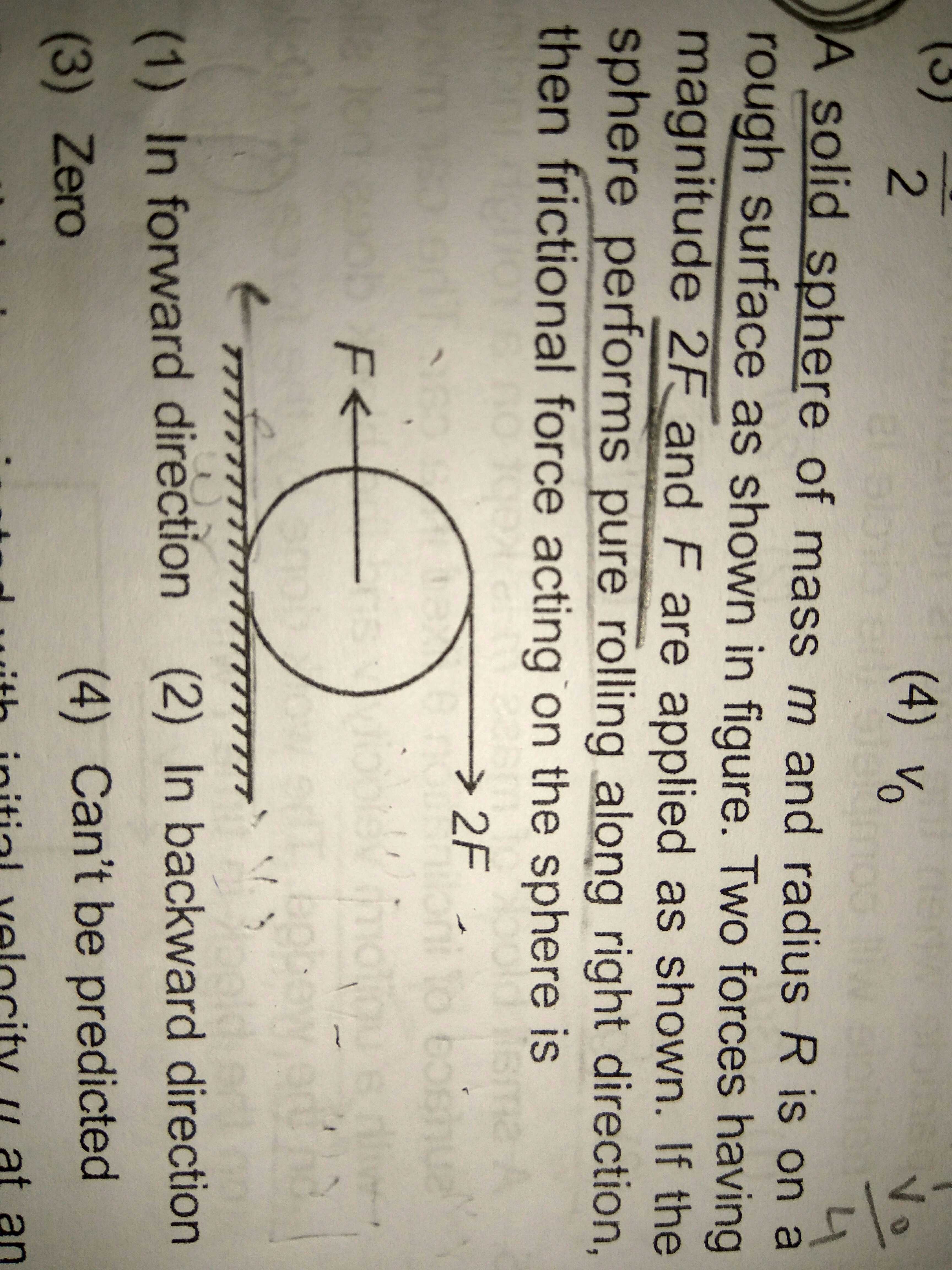
To understand the friction force acting on a solid sphere that is rolling without slipping, let’s break down the situation step by step. Imagine you have a solid sphere resting on a rough surface, and two forces are applied to it. The key here is that the sphere is rolling in a way that it doesn’t slide—this is what we call "pure rolling." Let's dive into the concepts that govern this scenario.
Understanding Rolling Motion
When an object rolls without slipping, every point on the surface of the sphere that is in contact with the ground is momentarily at rest relative to the ground. This means that the sphere is not sliding; instead, it is rotating about its center while translating forward. The friction force plays a crucial role in this process.
The Role of Friction
Friction is the force that prevents the sphere from sliding on the surface. In the case of pure rolling, static friction is what keeps the sphere rolling smoothly. If the surface were perfectly smooth, the sphere would slide instead of rolling, which is not what we want here.
Analyzing the Forces
Now, let’s consider the forces acting on the sphere. You mentioned two forces with the same magnitude, F. When these forces are applied, they create a net force that tends to accelerate the sphere in the direction of the applied forces. However, for the sphere to roll without slipping, the friction force must be sufficient to prevent any sliding.
Direction of Friction
In this scenario, the friction force will act in the opposite direction to the motion caused by the applied forces. If the forces F are pushing the sphere to the right, the friction force will act to the left. This friction force is what allows the sphere to roll forward instead of just sliding.
Determining the Magnitude of Friction
The magnitude of the friction force depends on several factors, including the applied forces and the sphere's tendency to rotate. If the applied forces are balanced in such a way that the sphere rolls without slipping, the friction force will adjust itself to ensure that condition is met. It will be enough to provide the necessary torque for rolling but not so much that it causes sliding.
Example Scenario
Imagine you are pushing a heavy ball on a rough surface. If you push gently, the ball rolls forward smoothly. However, if you push too hard, the ball might start to slide instead of rolling. The friction force is what keeps it rolling, and it adjusts based on how hard you push. In our case, as long as the applied forces are not too great, the friction force will be just enough to maintain pure rolling.
Final Thoughts
In summary, the friction force acting on the sphere is crucial for maintaining pure rolling motion. It acts in the opposite direction of the applied forces and adjusts itself to ensure that the sphere rolls without slipping. By visualizing the forces and understanding the role of friction, you can grasp how these concepts work together to create smooth rolling motion.