Flag Mechanics> A solid brass cylinder and a solid wooden...
question mark

A solid brass cylinder and a solid wooden cylinder have the same radius and mass, the wooden cylinder being longer. You release them together at the top of an incline. Which will beat the other to the bottom? Suppose that the cylinders are now made to be the same length (and radius) and that the masses are made to be equal by boring a hole along the axis of the brass cylinder. Which cylinder will win the race now? Explain your answers. Assume that the cylinders roll without slipping.

Amit Saxena , 10 Years ago
Grade upto college level
anser 2 Answers
Navjyot Kalra
Assume that the axis about which the cylinders rotates passes through its center of mass and runs parallel to its length. If M is the mass of the cylinder, L is its length and R the cross-sectional radius, then the rotational inertia of the cylinder about the
assumed axis is232-811_1.PNG
It is important to note that the rotational inertia of the cylinder about the assumed axis is independent of its length L .
If the solid brass cylinder has the same mass and radius as the wooden cylinder, then both the cylinders will reach the bottom of inclined plane together because, the rotational inertia of the cylinders will be same, which is232-403_1.PNG
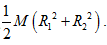
Even though the net mass of both the cylinders after boring a hole in brass cylinder is same, the rotational inertia of the brass cylinder will be larger. This is because the rotational inertia of the brass cylinder is mainly contributed from the particles away from the axis of rotation.
One can treat the brass cylinder as an annular cylinder with radius R1 and R2, such that its rotational inertia is 232-343_1.PNG 232-1829_1.PNG
Thus, this time the wooden cylinder will win the race.
Last Activity: 10 Years ago
erra akhil
In  the first both will reach at same time since they have same moment of inertia.
In the second case brass rod will be the first to reach bottom.
Acceleration on incline  plane can be calculated using this eqn; a = (gsinθ)/(1+(I/MR^2))
I=  moment of inertia
In first case both have same value of I.
But in second case I=(M(R^2 – r^2))/2 for brass cylinder.
Last Activity: 10 Years ago
star
LIVE ONLINE CLASSES

Prepraring for the competition made easy just by live online class.

tv

Full Live Access

material

Study Material

removal

Live Doubts Solving

assignment

Daily Class Assignments