Question icon
Grade 12th passMechanics

A rubber ball is dropped from a height of 5 m on a planet, where the acceleration due to gravity is not known. on bouncing it rises to 1.8 m. The ball loses its velocity by a factor of?
  1. 16/25
  2. 2/5
  3. 3/5
  4. 9/25

Profile image of Yogiraj
10 Years agoGrade 12th pass
Answers icon

3 Answers

Profile image of Riddhish Bhalodia
ApprovedApproved Tutor Answer10 Years ago
The energy loss is proportional in kinetica nd potential energy

hence
we have
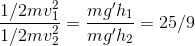
\frac{1/2mv_1^2}{1/2mv_2^2} = \frac{mg'h_1}{mg'h_2} = 25/9
\frac{v_1^2}{v_2^2} = 25/9
thus
\frac{v_1}{v_2} = 5/3
Profile image of JAHNAVI
10 Years ago
s = 1/2 a * t ^2 

make "a" whatever you want 
let a = 1 

s = 1.8 = 1/2 t^2 
t^2 = 3.6 

t = sqrt(3.6) 


on the "down" path 
s = 5 = 1/2 a * t^2 (a = 1 still) 
10 = t^2 
t=sqrt(10) 

velocity = acc * time 
v = a*t (a = 1 still) 

"up" v = at = sqrt(3.6) 
"down" v = at = sqrt(10) 

the "factor" [ the ball loses its velocity on bouncing?] 

= sqrt(3.6)/sqrt(10) = sqrt (.36) = 0.6 

,,,, my method is scary, but the answer is probly right ... 

good luck 
Profile image of Rishi Sharma
5 Years ago
Dear Student,
Please find below the solution to your problem.

A ball dropped from a height h on reaching the surface velocity is given by
V1= √2gh1
Let V2 be the velocity with which the ball bounces. It will attain a height h2 given by
V2= √2gh2
V2/V1 = √h2/h1
Given
h1 = 5 m h2 = 1.8 m
V2/V1 = √1.8/5 = √0.36 = 0.6
1 - V2/V1 = V1 - V2 / V1 = 1 - 0.6/1
0.4 = 2/5

Thanks and Regards