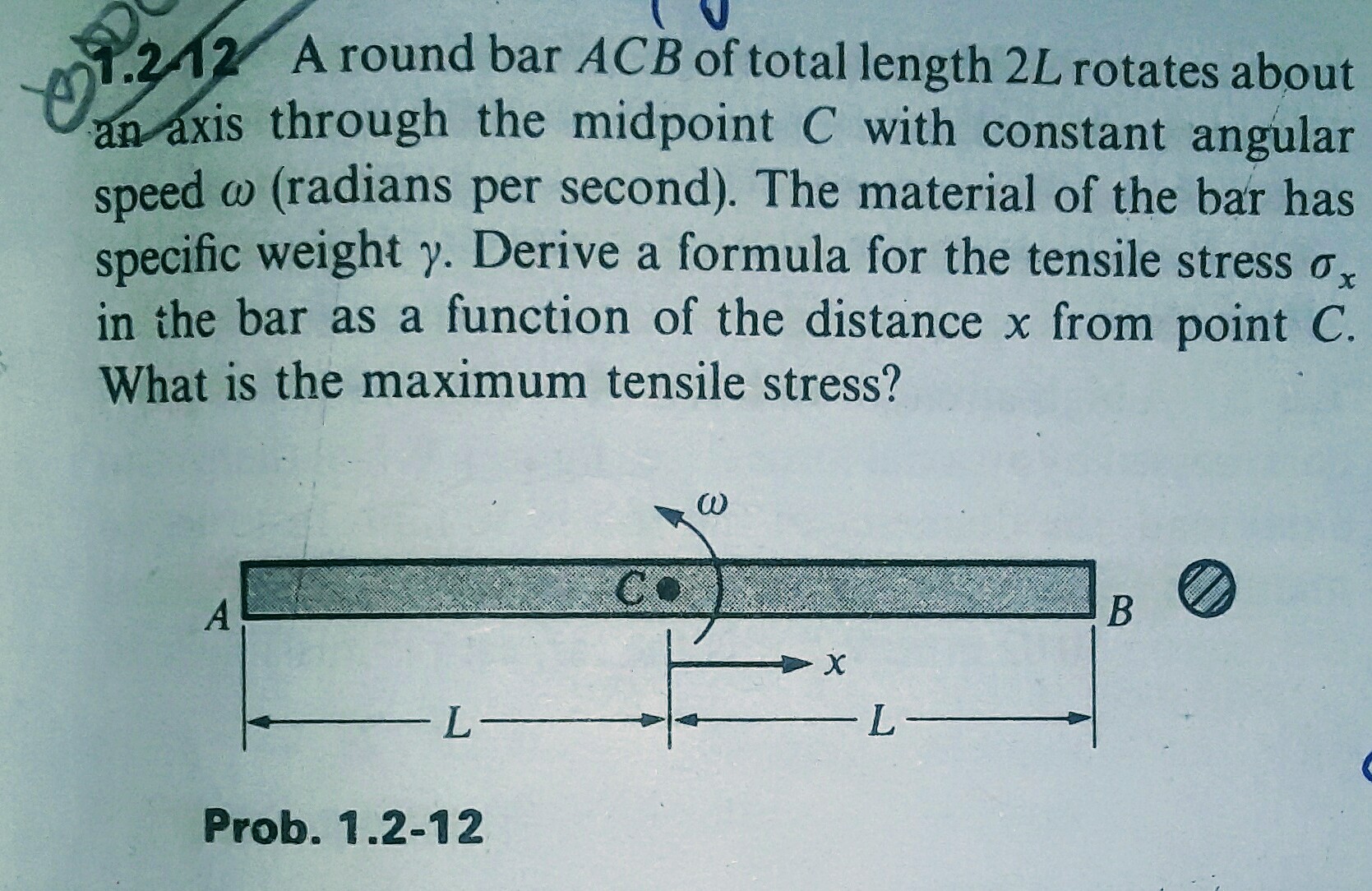
To determine the tensile stress at a distance \( x \) from the center of a rotating round bar of length \( 2L \), we need to consider the effects of rotation on the material of the bar. When the bar rotates, it experiences centrifugal forces that create stress within the material. Let's break this down step by step.
Understanding the Forces at Play
When the bar rotates about its midpoint, each infinitesimal segment of the bar experiences a centrifugal force that depends on its distance from the axis of rotation. The centrifugal force \( F \) acting on a small segment of the bar can be expressed as:
- Force: \( F = m \cdot a \)
- Acceleration: \( a = r \cdot \omega^2 \)
Here, \( m \) is the mass of the segment, \( r \) is the distance from the axis of rotation (which is \( x \) in this case), and \( \omega \) is the angular velocity of the bar.
Calculating the Mass of a Segment
To find the mass \( m \) of a small segment of the bar, we can use the formula:
- Mass: \( m = \rho \cdot A \cdot dx \)
Where \( \rho \) is the density of the material, \( A \) is the cross-sectional area of the bar, and \( dx \) is the infinitesimal length of the segment.
Finding the Centrifugal Force
Substituting the expression for mass into the force equation gives us:
- Centrifugal Force: \( F = \rho \cdot A \cdot dx \cdot (x \cdot \omega^2) \)
Stress Distribution Along the Bar
The tensile stress \( \sigma \) at a distance \( x \) from the center can be defined as the force per unit area. The total force acting on the segment can be integrated over the length of the bar to find the total tensile stress:
- Stress: \( \sigma(x) = \frac{F}{A} = \frac{\rho \cdot A \cdot (x \cdot \omega^2) \cdot dx}{A} \)
Thus, the tensile stress at a distance \( x \) from the center becomes:
- Tensile Stress: \( \sigma(x) = \rho \cdot x \cdot \omega^2 \cdot dx \)
Final Expression for Tensile Stress
To find the total tensile stress at any point \( x \) along the bar, we can summarize the relationship as:
- Final Stress Equation: \( \sigma(x) = \rho \cdot x \cdot \omega^2 \)
This equation indicates that the tensile stress increases linearly with the distance \( x \) from the center of the bar. The farther you are from the axis of rotation, the greater the tensile stress experienced by that segment of the bar due to the centrifugal force acting on it.
Example Application
For instance, if you have a bar made of steel (with a density of approximately \( 7850 \, \text{kg/m}^3 \)) rotating at an angular velocity of \( 10 \, \text{rad/s} \), and you want to find the tensile stress at a point \( 0.5L \) from the center, you would substitute \( x = 0.5L \) into the equation:
- Stress Calculation: \( \sigma(0.5L) = 7850 \cdot (0.5L) \cdot (10^2) \)
This will give you the tensile stress at that specific point, illustrating how the rotation affects the material properties of the bar.