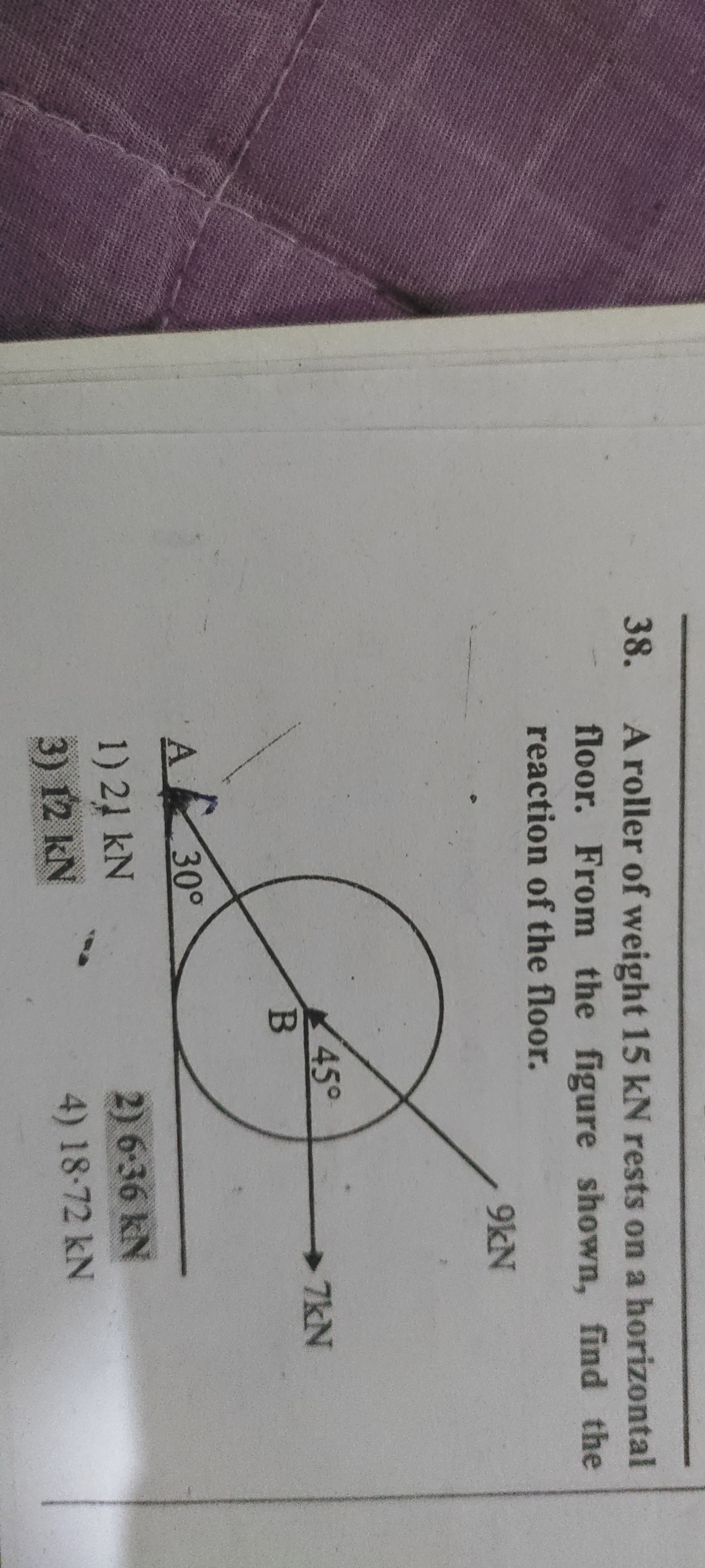
To determine the reaction force of the floor on the roller, we need to consider the forces acting on the roller. In this case, the roller has a weight of 15 kN, which acts vertically downward due to gravity. The reaction force from the floor will act vertically upward. Since the roller is at rest on a horizontal surface, we can apply the principles of static equilibrium.
Understanding Forces in Equilibrium
In static equilibrium, the sum of the forces acting on an object must equal zero. This means that the upward forces must balance the downward forces. For our roller, we can express this mathematically:
- Weight of the roller (downward force) = 15 kN
- Reaction force from the floor (upward force) = R
Since the roller is not moving, we can set up the equation:
Setting Up the Equation
Using the equilibrium condition:
R - Weight = 0
Substituting the known values:
R - 15 kN = 0
Solving for the Reaction Force
To find R, we simply rearrange the equation:
R = 15 kN
This means that the reaction force from the floor on the roller is equal to the weight of the roller, which is 15 kN. This is consistent with our understanding of how forces work in equilibrium.
Visualizing the Situation
Imagine the roller as a small cylinder resting on the floor. The weight pulls it down, while the floor pushes up with an equal force. If the roller were to be on an incline or if additional forces were applied, we would need to consider those factors as well. However, in this scenario, with no additional forces acting on the roller, the reaction force is straightforward.
Key Takeaways
- The reaction force from the floor is equal to the weight of the roller.
- In static equilibrium, the forces must balance out.
- Understanding these principles is crucial for analyzing more complex systems in physics and engineering.
In summary, the reaction force of the floor on the roller is 15 kN, acting upward to balance the downward weight of the roller. This fundamental concept of equilibrium is essential in many areas of physics and engineering, helping us understand how structures and objects interact with forces around them.