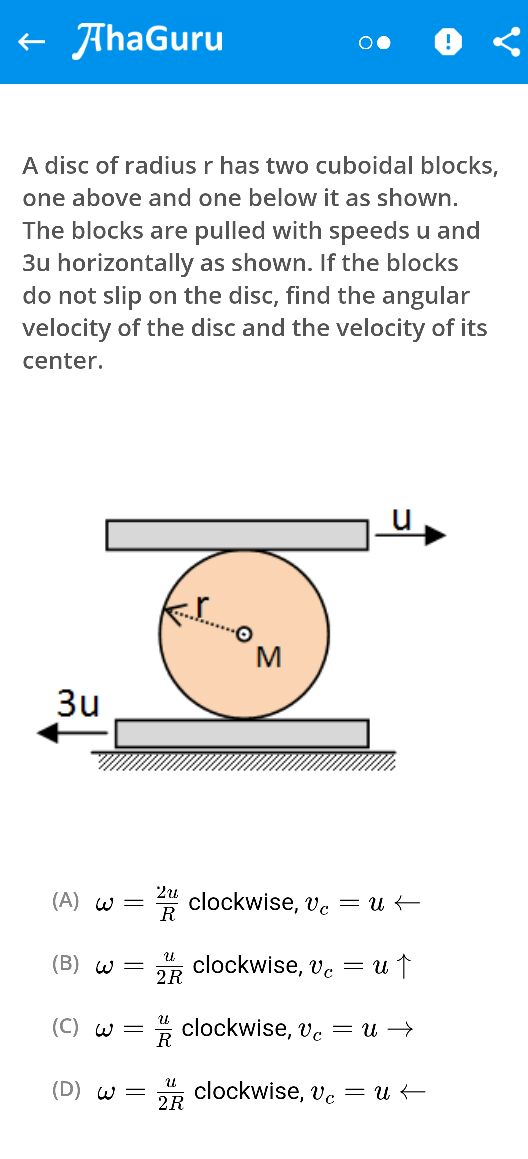
To solve the problem of a rectangular block placed on a cylinder, we need to analyze the forces and motions involved. When the block is pulled with a horizontal velocity \( u \) and there is no slipping between the surfaces, we can establish a relationship between the linear velocity of the block and the angular velocity of the cylinder.
Understanding the System
In this scenario, we have a rectangular block resting on a cylinder that is in contact with a rough floor. The roughness ensures that there is enough friction to prevent slipping. When the block is pulled, it exerts a force on the cylinder, causing it to rotate.
Key Concepts
- Linear Velocity: This is the speed at which the block is being pulled, denoted as \( u \).
- Angular Velocity: This is the rate of rotation of the cylinder, which we need to find.
- Radius of the Cylinder: Denoted as \( r \), this is crucial for relating linear and angular velocities.
Relating Linear and Angular Velocities
When there is no slipping, the linear velocity of the block at the point of contact with the cylinder must equal the tangential velocity of the cylinder's surface. The relationship between linear velocity \( v \) and angular velocity \( \omega \) is given by the formula:
v = r * ω
In our case, since the block is moving with a velocity \( u \), we can set this equal to the tangential velocity of the cylinder:
u = r * ω
Solving for Angular Velocity
To find the angular velocity \( ω \) of the cylinder, we can rearrange the equation:
ω = u / r
Final Expression
Thus, the angular velocity of the cylinder when the block is pulled with a velocity \( u \) and no slipping occurs is:
ω = u / r
Example Application
For instance, if the block is pulled with a speed of 4 m/s and the radius of the cylinder is 0.5 m, we can calculate the angular velocity:
ω = 4 m/s / 0.5 m = 8 rad/s
This means the cylinder rotates at 8 radians per second as the block is pulled. Understanding this relationship helps in analyzing similar problems involving rotational dynamics and friction.