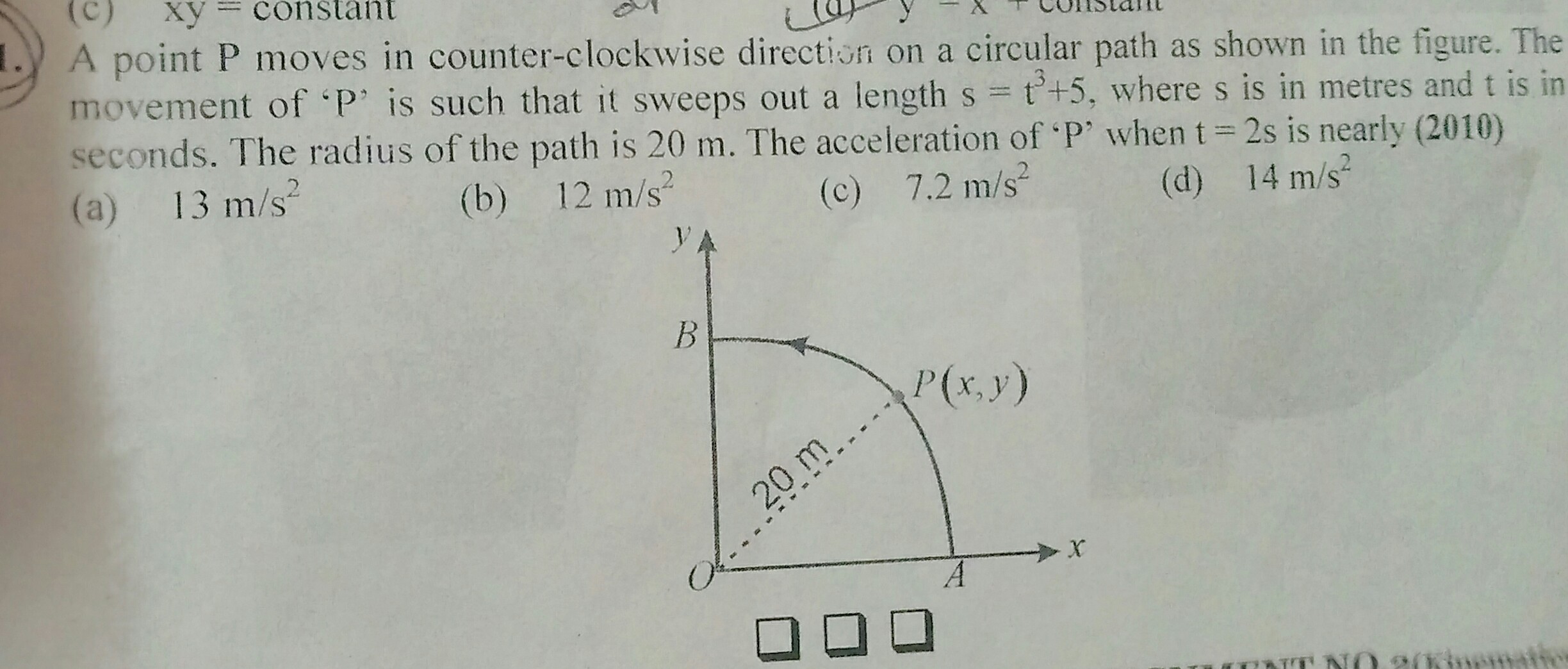
When we talk about a point moving in a counter-clockwise direction on a circular path, we are often discussing concepts related to circular motion and trigonometry. Let’s break this down step by step to understand what this means and how we can analyze the motion of point P.
Understanding Circular Motion
Circular motion refers to the movement of an object along the circumference of a circle. In this case, point P is moving counter-clockwise, which means it is traveling in the opposite direction of the hands of a clock. This direction is significant in various applications, including physics and engineering.
Key Characteristics of Circular Motion
- Radius: The distance from the center of the circle to point P.
- Angular Displacement: The angle through which point P moves around the circle, usually measured in radians or degrees.
- Linear Velocity: The speed at which point P travels along the circular path, which can be calculated using the formula \( v = r \cdot \omega \), where \( r \) is the radius and \( \omega \) is the angular velocity.
Mathematical Representation
To represent the position of point P mathematically, we can use parametric equations based on the angle θ (theta), which indicates how far point P has moved around the circle. If we assume the center of the circle is at the origin (0, 0) and the radius is r, the coordinates of point P can be expressed as:
- x = r * cos(θ)
- y = r * sin(θ)
As θ increases, point P moves counter-clockwise around the circle. For example, if θ = 0, point P is at (r, 0). If θ = π/2 (90 degrees), point P moves to (0, r), and so on.
Example of Motion
Let’s say point P has a radius of 5 units. If it moves counter-clockwise from an angle of 0 radians to π/2 radians, we can calculate its new position:
- At θ = 0: (5 * cos(0), 5 * sin(0)) = (5, 0)
- At θ = π/2: (5 * cos(π/2), 5 * sin(π/2)) = (0, 5)
This shows how point P transitions from the rightmost point of the circle to the topmost point as it moves counter-clockwise.
Applications of Circular Motion
Understanding the motion of a point on a circular path has practical applications in various fields:
- Physics: Analyzing the motion of planets, satellites, and other celestial bodies.
- Engineering: Designing gears and wheels that operate in circular motion.
- Animation: Creating realistic movements in video games and simulations.
In summary, the motion of point P in a counter-clockwise direction on a circular path can be described using mathematical equations and concepts of circular motion. This understanding is crucial for various scientific and practical applications, making it a fundamental topic in physics and mathematics.