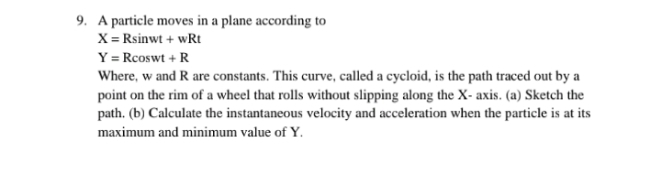
To analyze the motion of the particle described by the equations \( x = R \sin(\omega t) + R \omega t \) and \( y = R \cos(\omega t) \), we need to find the instantaneous velocity and acceleration at the maximum and minimum values of \( y \). Let's break this down step by step.
Understanding the Motion
The equations represent a particle moving in a plane, where \( R \) is a constant amplitude, \( \omega \) is the angular frequency, and \( t \) is time. The \( y \) component, given by \( y = R \cos(\omega t) \), oscillates between \( -R \) and \( R \). The maximum value of \( y \) occurs when \( \cos(\omega t) = 1 \) (i.e., \( y = R \)), and the minimum value occurs when \( \cos(\omega t) = -1 \) (i.e., \( y = -R \)).
Finding the Maximum and Minimum Values of y
- Maximum \( y \): \( y = R \) when \( \omega t = 0, 2\pi, 4\pi, \ldots \)
- Minimum \( y \): \( y = -R \) when \( \omega t = \pi, 3\pi, 5\pi, \ldots \)
Calculating Instantaneous Velocity
The instantaneous velocity \( \mathbf{v} \) of the particle can be found by differentiating the position equations with respect to time \( t \).
Velocity Components
We differentiate \( x \) and \( y \) as follows:
Velocity at Maximum y
At maximum \( y = R \) (when \( \omega t = 0 \)):
- \( v_x = R \omega \cos(0) + R \omega = 2R \omega \)
- \( v_y = -R \omega \sin(0) = 0 \)
Thus, the velocity at maximum \( y \) is \( \mathbf{v} = (2R \omega, 0) \).
Velocity at Minimum y
At minimum \( y = -R \) (when \( \omega t = \pi \)):
- \( v_x = R \omega \cos(\pi) + R \omega = -R \omega + R \omega = 0 \)
- \( v_y = -R \omega \sin(\pi) = 0 \)
Thus, the velocity at minimum \( y \) is \( \mathbf{v} = (0, 0) \).
Calculating Instantaneous Acceleration
The instantaneous acceleration \( \mathbf{a} \) is found by differentiating the velocity components with respect to time.
Acceleration Components
Acceleration at Maximum y
At maximum \( y = R \) (when \( \omega t = 0 \)):
- \( a_x = -R \omega^2 \sin(0) = 0 \)
- \( a_y = -R \omega^2 \cos(0) = -R \omega^2 \)
Thus, the acceleration at maximum \( y \) is \( \mathbf{a} = (0, -R \omega^2) \).
Acceleration at Minimum y
At minimum \( y = -R \) (when \( \omega t = \pi \)):
- \( a_x = -R \omega^2 \sin(\pi) = 0 \)
- \( a_y = -R \omega^2 \cos(\pi) = R \omega^2 \)
Thus, the acceleration at minimum \( y \) is \( \mathbf{a} = (0, R \omega^2) \).
Summary of Results
To summarize:
- At maximum \( y \) (\( y = R \)):
- Velocity: \( \mathbf{v} = (2R \omega, 0) \)
- Acceleration: \( \mathbf{a} = (0, -R \omega^2) \)
- At minimum \( y \) (\( y = -R \)):
- Velocity: \( \mathbf{v} = (0, 0) \)
- Acceleration: \( \mathbf{a} = (0, R \omega^2) \)
This analysis shows how the particle behaves at the extremes of its vertical motion, providing insights into both its velocity and acceleration at those points. If you have any further questions or need clarification on any part, feel free to ask!