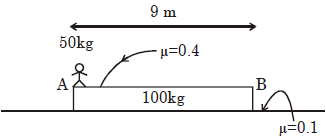
To analyze the scenario where a man runs on a plank while the plank itself accelerates, we can break down the problem into manageable parts. We need to consider the motion of both the man and the plank, applying the principles of physics, particularly Newton's laws of motion.
Understanding the Motion
We have a man who starts from rest and runs on a plank that is accelerating. The key points to note are:
- The plank remains stationary initially but starts to accelerate.
- The man takes 2 seconds to move from point A to point B.
- His final velocity with respect to the ground when he reaches point B is 8 m/s.
- The acceleration of the plank is 0.5 m/s² during this time.
Analyzing the Man's Motion
Since the man starts from rest, we can use the equations of motion to describe his movement. The final velocity (v) of the man is given as 8 m/s, and he takes 2 seconds (t) to reach this velocity. We can use the formula:
v = u + at
Here, u is the initial velocity (0 m/s since he starts from rest), a is the acceleration of the man, and t is the time (2 seconds). Rearranging the formula gives us:
a = (v - u) / t
Substituting the known values:
a = (8 m/s - 0 m/s) / 2 s = 4 m/s²
Considering the Plank's Motion
While the man accelerates, the plank also accelerates at 0.5 m/s². To find the distance covered by the man relative to the ground, we can use the equation:
s = ut + (1/2)at²
For the man, substituting the values gives:
s = 0 + (1/2)(4 m/s²)(2 s)² = 8 m
This means the man covers 8 meters relative to the ground. However, we also need to consider the distance the plank moves during this time.
Distance Covered by the Plank
Using the same formula for the plank, where its initial velocity is 0 and its acceleration is 0.5 m/s²:
s_plank = ut + (1/2)at²
Substituting the values for the plank:
s_plank = 0 + (1/2)(0.5 m/s²)(2 s)² = 1 m
Final Analysis
Now, we can summarize the findings:
- The man runs 8 meters relative to the ground.
- The plank moves 1 meter during the same time.
Thus, the distance the man covers relative to the plank is:
Distance relative to plank = Distance covered by man - Distance covered by plank
Distance = 8 m - 1 m = 7 m
In conclusion, the man effectively runs 7 meters relative to the plank while the plank itself moves 1 meter. This scenario beautifully illustrates the interplay between two objects in motion, showcasing how their respective accelerations and velocities can be analyzed using fundamental physics principles.