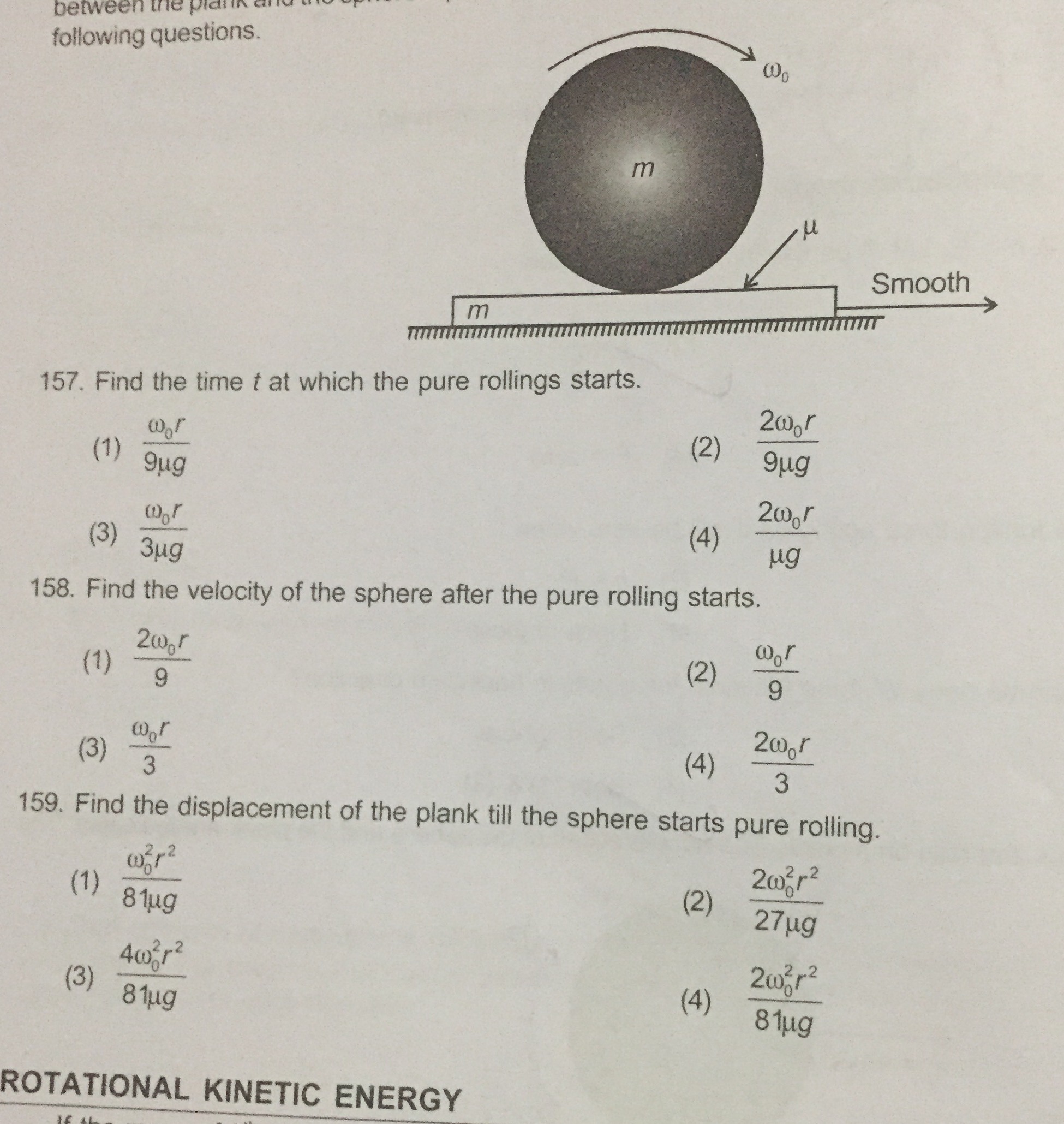
To analyze the scenario you've described, we need to consider the dynamics of both the plank and the sphere, particularly focusing on the forces and motions involved. Let's break down the situation step by step, addressing the key concepts and calculations necessary to understand how the sphere transitions from spinning to pure rolling on the plank.
Understanding the Initial Conditions
Initially, we have a solid sphere with mass 'm' and radius 'r' spinning with an angular velocity \( \omega_0 \). When this sphere is placed on the plank, which is also of mass 'm', the interaction between the sphere and the plank will determine how the motion evolves.
Frictional Forces at Play
The coefficient of friction \( \mu \) between the sphere and the plank plays a crucial role in this interaction. The frictional force will act to oppose the relative motion between the sphere and the plank. Initially, since the sphere is spinning, there will be a tendency for it to slide on the plank until it reaches a state of pure rolling.
Equations of Motion
To analyze the motion, we can use the following principles:
- Frictional Force: The maximum static frictional force \( f_{\text{max}} \) that can act on the sphere is given by \( f_{\text{max}} = \mu mg \), where \( g \) is the acceleration due to gravity.
- Torque and Angular Acceleration: The frictional force will create a torque on the sphere, causing it to decelerate its angular velocity. The torque \( \tau \) due to friction is given by \( \tau = f \cdot r \), leading to an angular deceleration \( \alpha \) calculated as \( \alpha = \frac{\tau}{I} \), where \( I \) is the moment of inertia of the sphere, \( I = \frac{2}{5}mr^2 \).
- Linear Acceleration: The same frictional force will also cause a linear acceleration \( a \) of the sphere, given by \( a = \frac{f}{m} \).
Transition to Pure Rolling
For the sphere to transition to pure rolling, the condition that must be satisfied is that the linear velocity \( v \) of the center of mass of the sphere must equal the angular velocity \( \omega \) multiplied by the radius \( r \) of the sphere:
Condition for Pure Rolling: \( v = r \omega \)
Calculating the Time to Reach Pure Rolling
Initially, the sphere has a linear velocity of zero relative to the plank. As the frictional force acts, it accelerates the sphere while simultaneously reducing its angular velocity. The equations governing these changes can be set up as follows:
- The linear acceleration of the sphere due to friction is \( a = \frac{\mu mg}{m} = \mu g \).
- The angular deceleration is \( \alpha = \frac{f \cdot r}{I} = \frac{\mu mg \cdot r}{\frac{2}{5}mr^2} = \frac{5\mu g}{2r} \).
Using these accelerations, we can find the time \( t \) it takes for the sphere to reach the condition for pure rolling. The initial angular velocity is \( \omega_0 \), and it decreases at a rate of \( \alpha \). The linear velocity \( v \) increases at a rate of \( a \). Setting up the equations:
After time \( t \):
- Linear velocity: \( v = a t = \mu g t \)
- Angular velocity: \( \omega = \omega_0 - \alpha t = \omega_0 - \frac{5\mu g}{2r} t \)
Setting the condition for pure rolling:
\( \mu g t = r \left( \omega_0 - \frac{5\mu g}{2r} t \right) \)
Solving for Time
Rearranging gives us a quadratic equation in terms of \( t \). Solving this will yield the time it takes for the sphere to transition to pure rolling. This involves substituting values for \( \mu \), \( g \), \( r \), and \( \omega_0 \) based on the specific scenario you are analyzing.
Final Thoughts
In summary, the transition from spinning to pure rolling involves understanding the interplay of forces, torques, and the resulting accelerations. By applying Newton's laws and the conditions for rolling motion, we can derive the necessary equations to find the time it takes for the sphere to achieve pure rolling on the plank. If you have specific values or further questions about the calculations, feel free to ask!