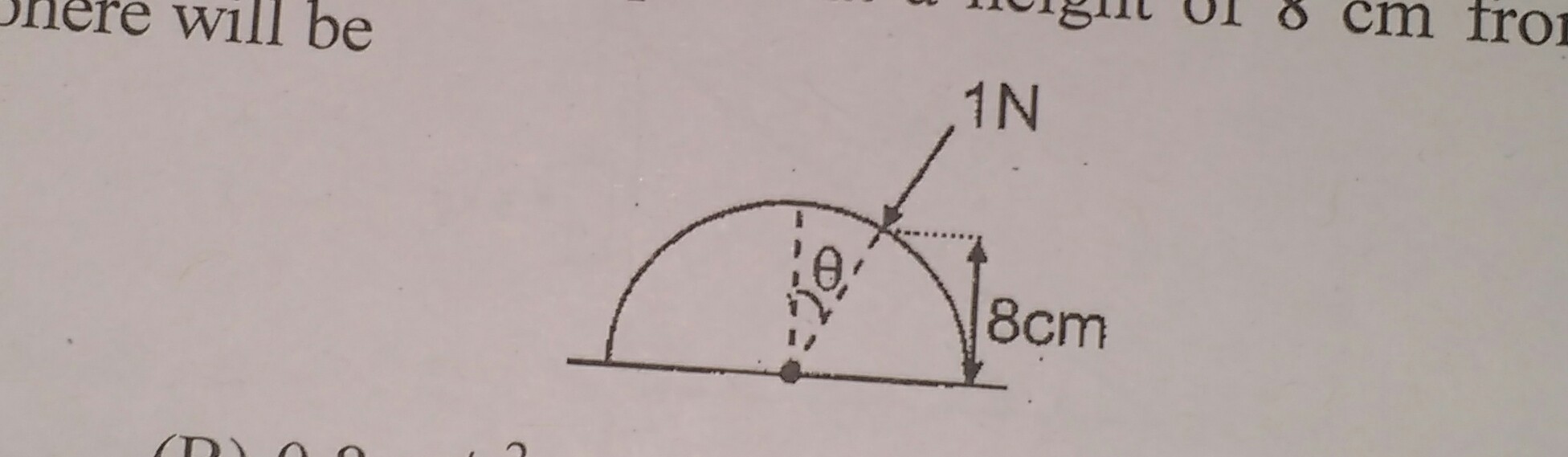
To determine the acceleration of the hemisphere when a force is applied, we need to analyze the situation using Newton's second law of motion, which states that the force acting on an object is equal to the mass of that object multiplied by its acceleration (F = ma). In this case, we have a hemisphere with a mass of 1 kg and a radius of 10 cm, and a force of 1 N is applied. Let's break this down step by step.
Understanding the Forces at Play
First, we need to identify the forces acting on the hemisphere. The applied force of 1 N is acting horizontally. Since the table is smooth, we can assume there is negligible friction acting against the motion of the hemisphere.
Calculating Acceleration
According to Newton's second law:
- F = 1 N (the applied force)
- m = 1 kg (the mass of the hemisphere)
We can rearrange the formula to solve for acceleration (a):
a = F / m
Substituting the known values:
a = 1 N / 1 kg = 1 m/s²
Considering the Geometry of the Hemisphere
While the acceleration calculation is straightforward, we should also consider how the hemisphere might behave when the force is applied. The force will cause the hemisphere to start rolling or sliding, depending on how it interacts with the surface. However, since we are told the table is smooth, we can assume that it will primarily slide without rolling.
Final Thoughts
In this scenario, the acceleration of the hemisphere is 1 m/s² in the direction of the applied force. This result is derived from the basic principles of physics and illustrates how mass and force interact to produce acceleration. If there were friction or other forces involved, we would need to account for those in our calculations, but in this case, the smooth surface simplifies our analysis.