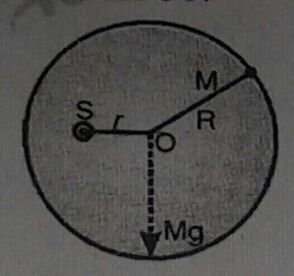
To determine the angular acceleration of a disc that is free to rotate about a shaft at a distance from its center, we can apply some fundamental principles of rotational dynamics. Let's break down the problem step by step.
Understanding the System
We have a disc with mass \( M \) and radius \( R \). It is pivoted at a point \( S \), which is at a distance \( r \) from the center \( O \) of the disc. When the disc is released, it will start to rotate about the point \( S \) due to the gravitational force acting on it.
Forces Acting on the Disc
The primary force acting on the disc is its weight, which can be expressed as:
- Weight \( W = Mg \), where \( g \) is the acceleration due to gravity.
This weight acts downward through the center of mass of the disc, which is located at point \( O \).
Torque Calculation
To find the angular acceleration, we need to calculate the torque (\( \tau \)) about the pivot point \( S \). Torque is given by the equation:
In our case, the force \( F \) is the weight of the disc acting at the center of mass, and the distance \( r \) is the perpendicular distance from the line of action of the weight to the pivot point \( S \).
Finding the Perpendicular Distance
The perpendicular distance from the center of mass \( O \) to the line of action of the weight can be found using geometry. This distance is given by:
- Perpendicular distance \( d = r - \frac{R}{2} \) (assuming the pivot is below the center of the disc).
Thus, the torque can be expressed as:
Moment of Inertia
The moment of inertia (\( I \)) of the disc about the pivot point \( S \) can be calculated using the parallel axis theorem:
Where \( I_{cm} \) is the moment of inertia of the disc about its center, given by:
- \( I_{cm} = \frac{1}{2} MR^2 \)
Substituting this into the equation gives:
- \( I = \frac{1}{2} MR^2 + M(r - \frac{R}{2})^2 \)
Applying Newton's Second Law for Rotation
According to Newton's second law for rotation, the angular acceleration (\( \alpha \)) can be found using the equation:
Substituting the expressions for torque and moment of inertia, we can solve for angular acceleration:
- \( d \cdot Mg = \left( \frac{1}{2} MR^2 + M(r - \frac{R}{2})^2 \right) \alpha \)
Final Expression for Angular Acceleration
Rearranging the equation to solve for \( \alpha \) gives:
- \( \alpha = \frac{d \cdot g}{\frac{1}{2} R + (r - \frac{R}{2})^2} \)
This expression allows you to calculate the angular acceleration of the disc based on its mass, radius, and the distance from the pivot point to the center of the disc. By plugging in the values for \( M \), \( R \), \( r \), and \( g \), you can find the specific angular acceleration for your scenario.