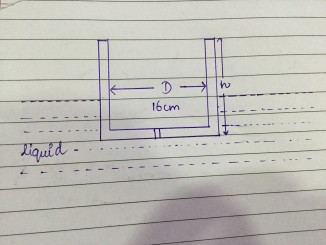
To determine the minimum height of a cylindrical vessel that floats in a liquid without sinking, we need to consider the principles of buoyancy and the effects of the leak. The key here is to ensure that the vessel remains buoyant even as water enters through the leak. Let's break this down step by step.
Understanding Buoyancy
Buoyancy is the upward force exerted by a fluid that opposes the weight of an object immersed in it. According to Archimedes' principle, the buoyant force acting on an object is equal to the weight of the fluid displaced by the object. For the vessel to float, the weight of the liquid displaced must equal the weight of the vessel plus any additional weight from the liquid inside it.
Given Parameters
- Thickness of the vessel: 2 cm
- Depth of immersion: 8 cm
- Let the height of the vessel be denoted as H cm.
Calculating the Volume Displaced
The volume of the liquid displaced by the submerged part of the vessel can be calculated using the formula for the volume of a cylinder:
Volume = πr²h
In this case, the height of the submerged part is 8 cm. If we denote the radius of the vessel as r, the volume of the displaced liquid (V_displaced) is:
V_displaced = πr²(8)
Weight Considerations
The weight of the displaced liquid (W_displaced) can be expressed as:
W_displaced = V_displaced × ρ_liquid × g
Where ρ_liquid is the density of the liquid and g is the acceleration due to gravity.
Effect of the Leak
When the leak develops at the bottom of the vessel, water will start to enter the vessel. For the vessel to remain afloat, the weight of the water entering must not exceed the buoyant force. As water fills the vessel, the total weight of the vessel increases, which could lead to sinking if the height of the vessel is not sufficient.
Minimum Height Calculation
To ensure that the vessel does not sink, we need to find the minimum height (H) such that the weight of the water that can enter the vessel does not exceed the buoyant force. The vessel must have enough height to accommodate the water that enters through the leak while still maintaining buoyancy.
Assuming that the vessel is completely filled with water when it starts to sink, we can set up the equation:
Weight of the vessel + Weight of the water inside = Weight of the displaced liquid
Let’s denote the weight of the vessel as W_vessel. The weight of the water that can enter the vessel is given by:
Weight_water = ρ_water × V_water = ρ_water × πr²(H - 8)
For the vessel to float, we need:
W_vessel + ρ_water × πr²(H - 8) ≤ ρ_liquid × πr²(8)
Final Consideration
To find the minimum height H, we can rearrange the equation and solve for H. However, without specific values for the weights and densities, we can conclude that:
The height of the vessel must be greater than 8 cm to allow for the additional water entering through the leak. A practical approach would be to ensure that H is at least 10 cm or more, depending on the specific densities involved.
In summary, the minimum height of the vessel should be carefully calculated based on the specific conditions, but it must exceed the depth of immersion (8 cm) to ensure that it does not sink when the leak occurs.