

Grade 11Mechanics
A cylinder is in rotational equilimbrium on an inclined plane.find the minimum u between the log and inclined plane
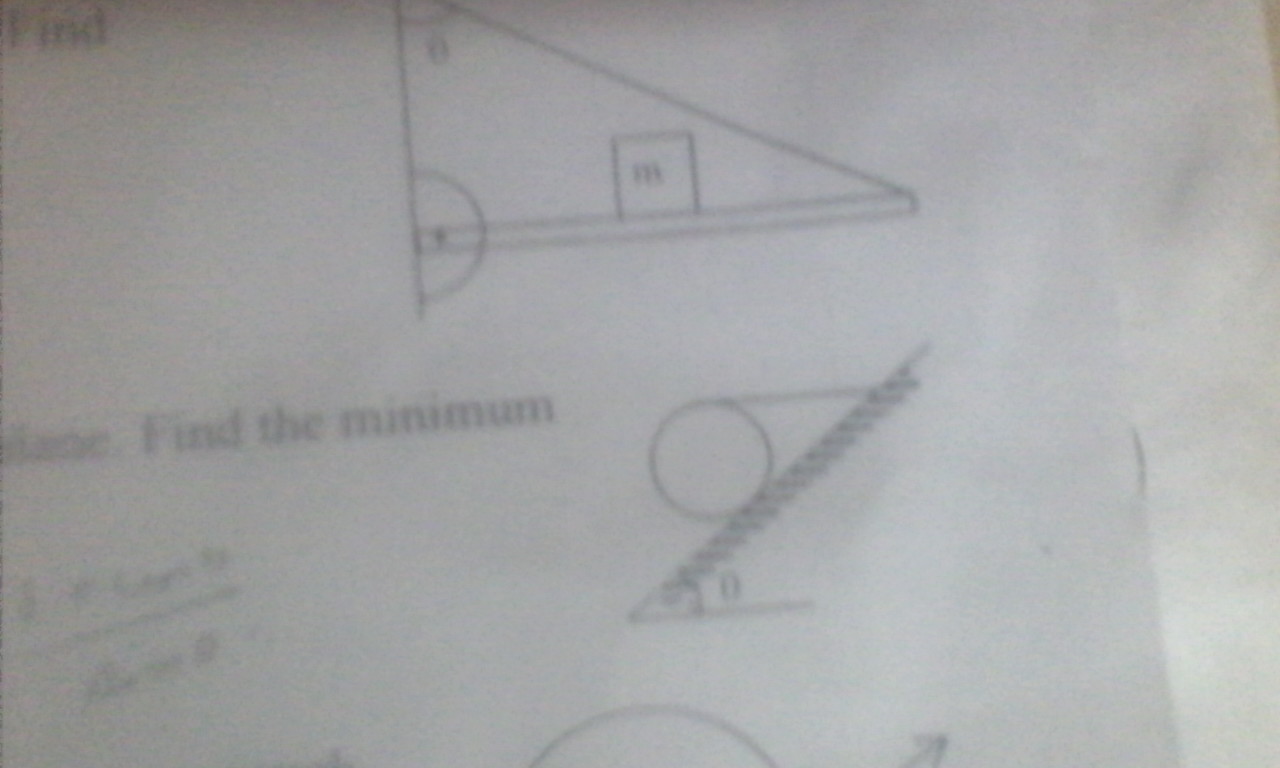


 Approved Tutor Answer1 Year ago
To determine the minimum coefficient of static friction (μ) required for a cylinder to remain in rotational equilibrium on an inclined plane, we need to analyze the forces acting on the cylinder and the conditions for equilibrium. Let's break this down step by step.
When a cylinder is placed on an inclined plane, several forces act on it:
For the cylinder to be in rotational equilibrium, the net torque about the center of the cylinder must be zero. The forces can be analyzed as follows:
The weight of the cylinder (W = mg, where m is mass and g is acceleration due to gravity) can be split into two components:
The normal force (N) balances the perpendicular component of the weight:
N = W_perpendicular = mg cos(θ)
The frictional force that prevents the cylinder from sliding down the incline is given by:
F_f = μN = μ(mg cos(θ))
For the cylinder to remain stationary (in rotational equilibrium), the frictional force must be equal to or greater than the component of the weight acting down the incline:
F_f ≥ W_parallel
Substituting the expressions we derived:
μ(mg cos(θ)) ≥ mg sin(θ)
We can simplify this inequality by dividing both sides by mg (assuming m and g are not zero):
μ cos(θ) ≥ sin(θ)
Now, rearranging gives us:
μ ≥ tan(θ)
The minimum coefficient of static friction (μ) required for the cylinder to remain in rotational equilibrium on the inclined plane is:
μ ≥ tan(θ)
This means that the steeper the incline (larger θ), the greater the coefficient of friction needed to prevent the cylinder from sliding down. For example, if the incline is at 30 degrees, then:
μ ≥ tan(30°) ≈ 0.577
In practical terms, this relationship helps us understand how friction plays a crucial role in maintaining equilibrium on slopes, whether in engineering applications or everyday scenarios.

Three identical balls are placed on a frictionless
horizontal surface touching each other. They stick to
each other because of adhesive. Another ball of same
radius and mass m is placed over the void created by
the three balls. Find the forces applied by the balls
kept on the floor to each other if the system remains
in equilibrium.
Last Activity: 9 Months ago
A car loaded with water having total mass 1000 kg moves on a straight horizontal Road starting from rest under the action of a force of 100 Newton. The water spills throw a small hole in the bottom at a rate of 0.1 KG per second the velocity of cart after 300 seconds is nearly.
11
21
31
41
Last Activity: 10 Months ago
Last Activity: 3 Years ago
Last Activity: 3 Years ago