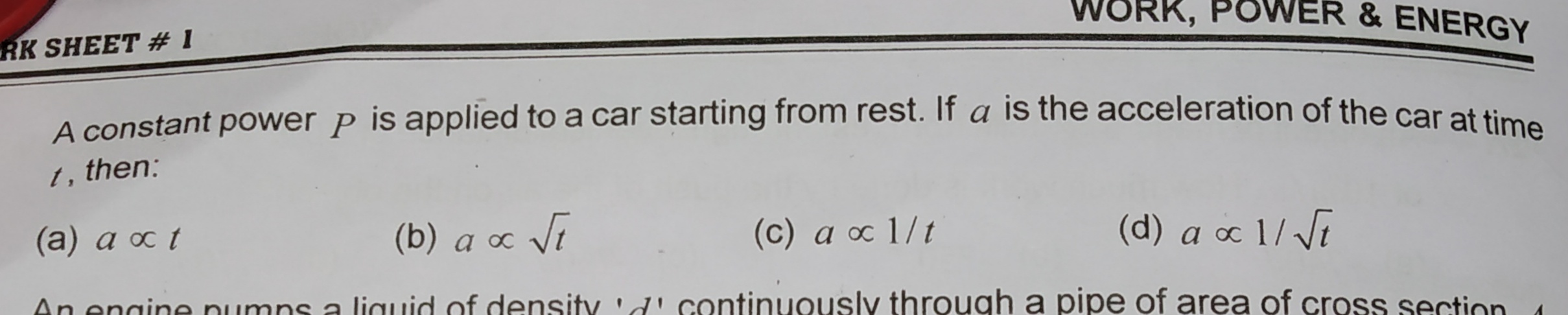
To understand how acceleration behaves when a constant power is applied to a car starting from rest, we need to delve into the relationship between power, force, and acceleration. Let's break this down step by step.
Power and Its Relationship to Force and Velocity
Power (P) is defined as the rate at which work is done or energy is transferred. In the context of a car, when a constant power is applied, we can express it mathematically as:
P = F * v
Here, F is the force applied to the car, and v is the velocity of the car. Since the car starts from rest, its initial velocity is zero, and as it accelerates, its velocity increases.
Understanding Acceleration
Acceleration (a) is defined as the change in velocity over time. According to Newton's second law, we can relate force and acceleration as follows:
F = m * a
where m is the mass of the car. By combining these equations, we can express power in terms of acceleration:
P = m * a * v
Expressing Velocity in Terms of Acceleration
To find the relationship between acceleration and time, we need to express velocity in terms of acceleration. Since the car starts from rest, we can use the kinematic equation:
v = a * t
Substituting this into the power equation gives us:
P = m * a * (a * t)
This simplifies to:
P = m * a² * t
Finding the Relationship Between Acceleration and Time
From the equation P = m * a² * t, we can isolate acceleration:
a² = P / (m * t)
Taking the square root of both sides, we find:
a = √(P / (m * t))
Analyzing the Proportionality
This equation shows that acceleration is inversely proportional to the square root of time:
a ∝ 1/√t
As time increases, the acceleration decreases, which makes sense because, with constant power, the car's velocity increases, leading to a decrease in acceleration over time.
Conclusion
In summary, when a constant power is applied to a car starting from rest, the acceleration of the car is inversely proportional to the square root of time. Therefore, the correct answer to your question is:
c. a proportional to 1/√t