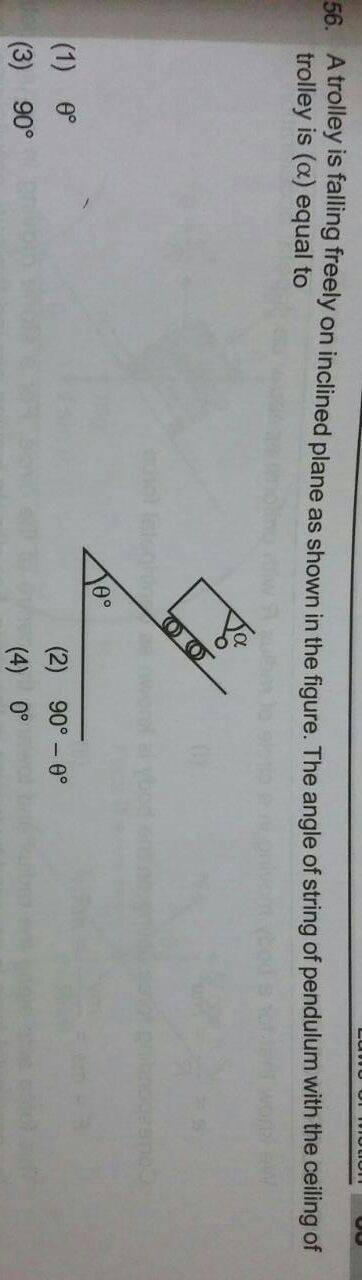
To determine the angle alpha that a pendulum subtends with a cart moving on an inclined plane at an angle theta, we need to analyze the forces acting on the pendulum and how they relate to the motion of the cart. This situation involves concepts from physics, particularly dynamics and equilibrium.
Understanding the Forces at Play
When the cart is on an inclined plane, it experiences gravitational force acting downwards and a normal force perpendicular to the surface of the incline. The pendulum, which is hanging from the cart, also experiences these forces, but we need to consider the effective forces acting on it due to the cart's acceleration.
Identifying the Components of Forces
Let's break down the forces acting on the pendulum:
- Gravitational Force (Fg): This acts vertically downwards and can be resolved into two components: one parallel to the incline and one perpendicular to it.
- Normal Force (N): This acts perpendicular to the surface of the incline.
- Tension (T): This acts along the string of the pendulum.
Setting Up the Equations
When the cart accelerates down the incline, the pendulum will swing to a certain angle alpha. At this point, the forces acting on the pendulum must be in equilibrium. The key is to balance the forces in the direction parallel and perpendicular to the incline.
The equations can be set up as follows:
- In the direction parallel to the incline: T sin(alpha) = m g sin(theta)
- In the direction perpendicular to the incline: T cos(alpha) = m g cos(theta) + N
Finding the Relationship Between Angles
From the first equation, we can express tension T in terms of the gravitational force and the angles:
T = (m g sin(theta)) / sin(alpha)
Substituting this expression for T into the second equation allows us to eliminate T and solve for alpha:
(m g sin(theta) / sin(alpha)) cos(alpha) = m g cos(theta) + N
Solving for Alpha
To find the angle alpha, we can rearrange the equation and isolate sin(alpha) and cos(alpha). This leads us to a relationship involving the tangent of the angles:
tan(alpha) = (g sin(theta)) / (g cos(theta) + N/m)
Assuming the normal force N is negligible or can be approximated, we can simplify this further. In many practical scenarios, if the cart is accelerating down the incline, we can find a direct relationship between alpha and theta:
alpha = theta
Conclusion
In summary, the angle alpha that the pendulum subtends with the cart depends on the incline angle theta and the forces acting on both the cart and the pendulum. By analyzing the forces and setting up the equations, we can derive a relationship that helps us understand how the pendulum behaves in this dynamic system. This approach not only illustrates the principles of physics but also enhances our understanding of motion and forces in inclined planes.