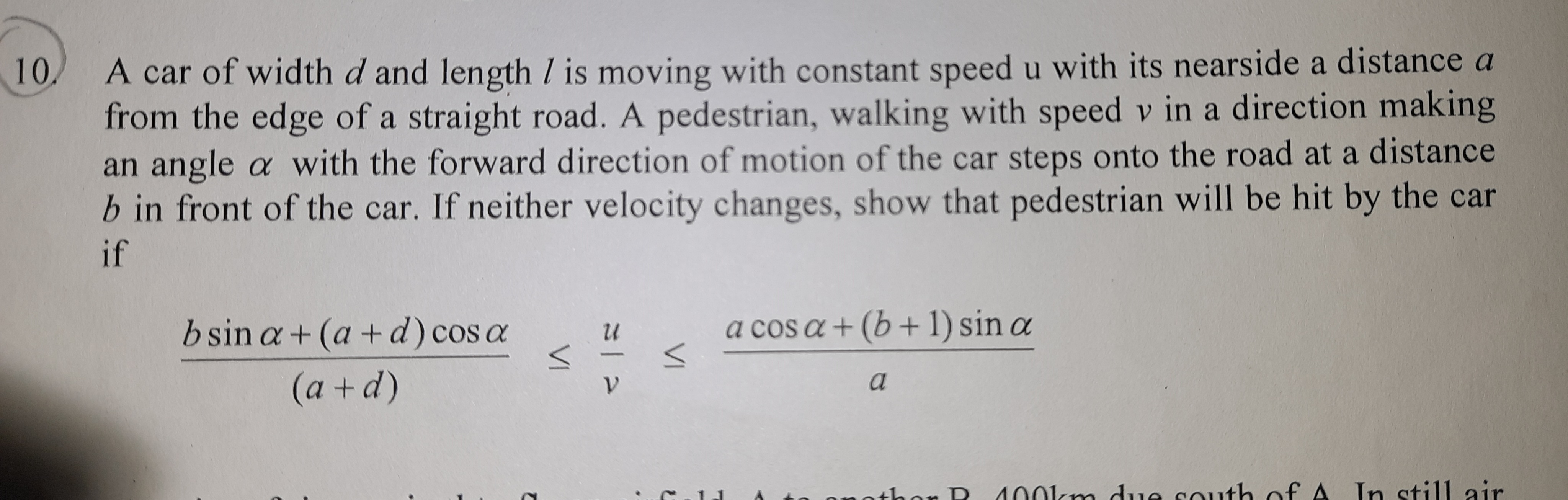
To determine whether the pedestrian will be hit by the car, we need to analyze the situation using some basic principles of relative motion and geometry. Let's break down the problem step by step.
Understanding the Scenario
We have a car moving with a constant speed \( u \) along a straight road. The car has a width \( d \) and a length \( l \). The nearest side of the car is at a distance \( a \) from the edge of the road. A pedestrian is walking with speed \( v \) at an angle \( x \) relative to the forward direction of the car. The pedestrian steps onto the road at a distance \( b \) in front of the car.
Visualizing the Geometry
To visualize this, imagine the car moving from left to right. The pedestrian is positioned at a point \( b \) in front of the car, and as they walk at an angle \( x \), their path will create a right triangle with the road. The horizontal component of the pedestrian's velocity is \( v \cos x \), and the vertical component is \( v \sin x \).
Time Until Collision
Next, we need to calculate the time it takes for the car to reach the point where the pedestrian stepped onto the road. The distance from the front of the car to the pedestrian is \( b \). The time \( t_c \) for the car to reach the pedestrian is given by:
Pedestrian's Position Over Time
During the time \( t_c \), the pedestrian will also be moving. The distance the pedestrian travels in the time \( t_c \) can be calculated using their velocity components:
- Horizontal distance: \( d_{p,x} = v \cos x \cdot t_c = v \cos x \cdot \frac{b}{u} \)
- Vertical distance: \( d_{p,y} = v \sin x \cdot t_c = v \sin x \cdot \frac{b}{u} \)
Collision Condition
For the pedestrian to be hit by the car, they must be within the width of the car when it reaches their position. The pedestrian's horizontal position relative to the car must satisfy:
Substituting for \( d_{p,x} \), we have:
- \( a + d \geq \frac{v \cos x \cdot b}{u} \)
Rearranging gives us:
- \( b \sin x + (a + d) \cos x \leq \frac{u}{v} (a + d) \)
Upper Bound for Collision
Now, we also need to consider the maximum distance the pedestrian can walk before the car reaches them. The pedestrian's position must also satisfy:
- \( d_{p,y} \leq a \cos x + (b + l) \sin x \)
Substituting for \( d_{p,y} \) gives us:
- \( \frac{v \sin x \cdot b}{u} \leq a \cos x + (b + l) \sin x \)
Rearranging this condition leads to:
- \( \frac{u}{v} \geq \frac{a \cos x + (b + l) \sin x}{b \sin x} \)
Final Inequality
Combining both conditions, we arrive at the inequality:
- \( b \sin x + (a + d) \cos x \leq u/v \leq a \cos x + (b + l) \sin x \)
This shows that if the speed ratio \( u/v \) falls within the derived bounds, the pedestrian will be hit by the car. Thus, the conditions for collision are clearly defined by the inequalities established.