

Grade 7Mechanics
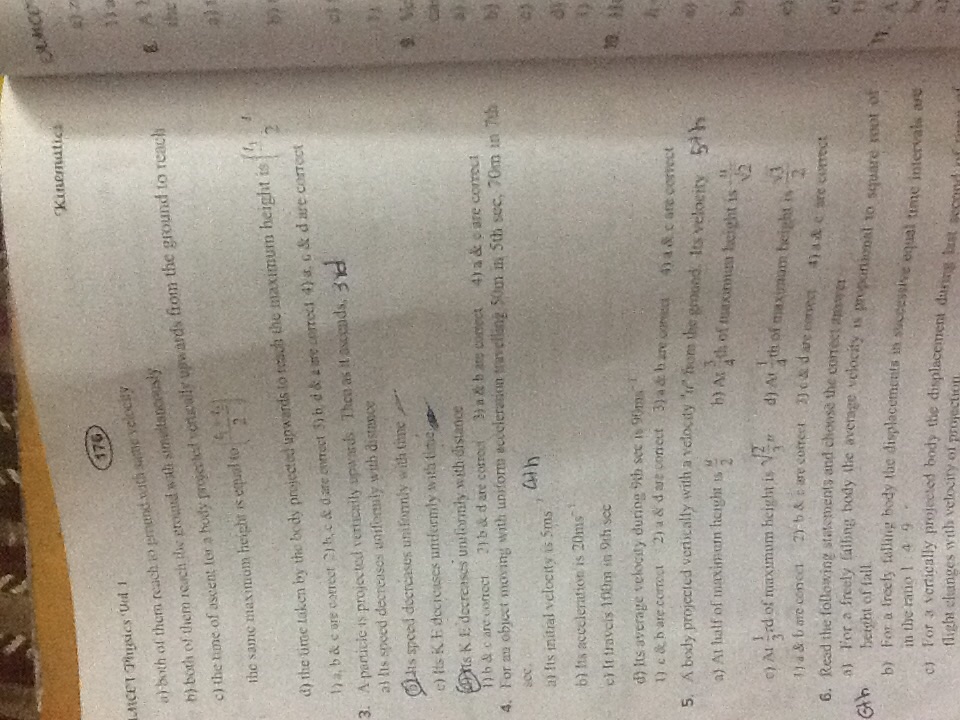
A body projected vertically with a velocity “u” from the ground . It’s velocity at ¼ th of maximum height is
A body projected vertically with a velocity “u” from the ground . It’s velocity at ¼ th of maximum height is


 Approved Tutor Answer1 Year ago
When a body is projected vertically upward with an initial velocity "u," it experiences a change in velocity due to the acceleration caused by gravity. To determine the velocity at one-fourth of its maximum height, we first need to understand a few key concepts related to projectile motion.
The maximum height (H) reached by the body can be calculated using the formula:
Here, "g" represents the acceleration due to gravity, approximately 9.81 m/s². This formula arises from the principle that the kinetic energy at the point of projection is converted into potential energy at the maximum height.
To find the height at one-fourth of the maximum height, we can use:
Next, we can use the kinematic equations to find the velocity at this height. The relevant equation is:
In this case, "h" is the height at one-fourth of the maximum height, which we calculated as (u²) / (8g). Substituting this value into the equation gives:
Now, substituting for "h" in the kinematic equation:
This simplifies to:
Combining the terms results in:
To find the velocity "v," we take the square root of both sides:
This further simplifies to:
Therefore, the velocity of the body at one-fourth of its maximum height is:
This means that at this point in its trajectory, the body retains a significant portion of its initial velocity, specifically about 86.6% of it, as it continues to ascend before reaching its peak.

Three identical balls are placed on a frictionless
horizontal surface touching each other. They stick to
each other because of adhesive. Another ball of same
radius and mass m is placed over the void created by
the three balls. Find the forces applied by the balls
kept on the floor to each other if the system remains
in equilibrium.
Last Activity: 10 Months ago
A car loaded with water having total mass 1000 kg moves on a straight horizontal Road starting from rest under the action of a force of 100 Newton. The water spills throw a small hole in the bottom at a rate of 0.1 KG per second the velocity of cart after 300 seconds is nearly.
11
21
31
41
Last Activity: 10 Months ago
Last Activity: 3 Years ago
Last Activity: 3 Years ago