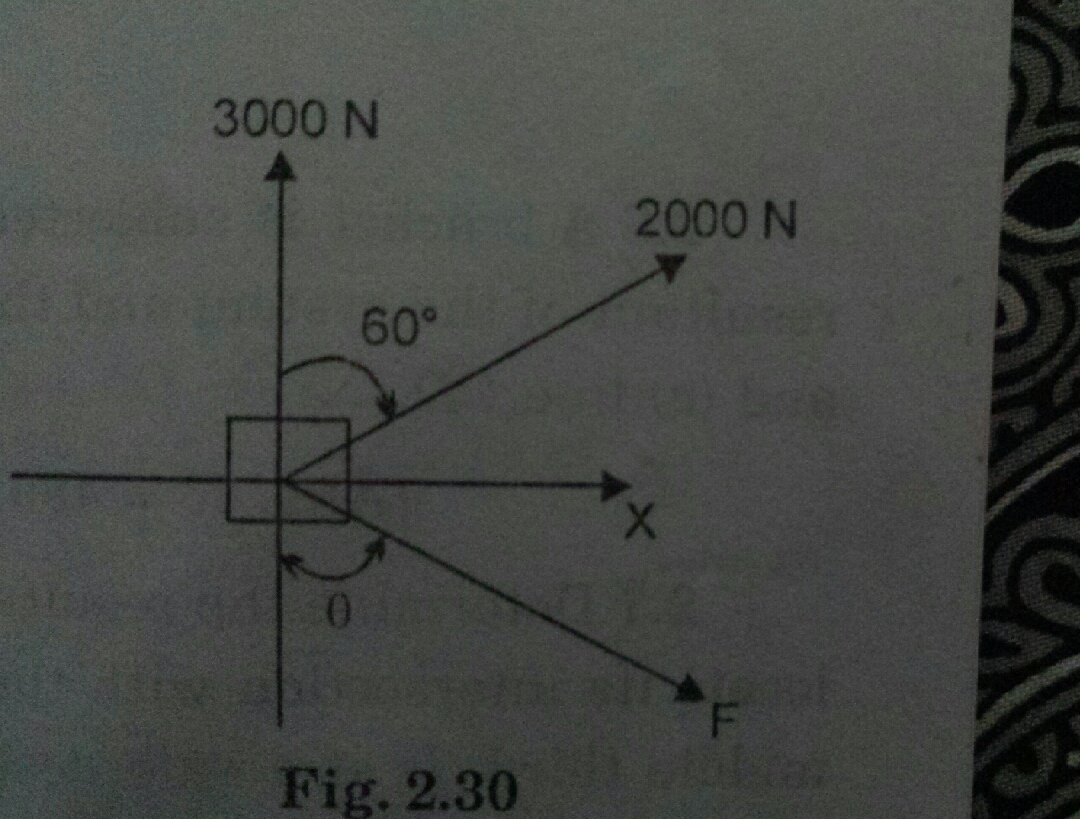
To determine the direction of the force \( F \) such that the resultant force is directed along the X-axis, we need to analyze the components of the forces acting on the body. The resultant force is the vector sum of all individual forces acting on the body. Let's break this down step by step.
Understanding Force Components
When a force is applied at an angle, it can be resolved into two components: one along the X-axis and another along the Y-axis. The goal here is to ensure that the Y-component of the resultant force cancels out, leaving only the X-component.
Resolving Forces
Let's denote the force \( F \) as having a magnitude and an angle \( \theta \) with respect to the X-axis. The components of the force can be expressed as:
- X-component: \( F_x = F \cdot \cos(\theta) \)
- Y-component: \( F_y = F \cdot \sin(\theta) \)
For the resultant force to be purely in the X-direction, the sum of the Y-components of all forces acting on the body must equal zero. This means:
Setting Up the Equations
Assuming there is another force acting on the body (let's call it \( R \)), we can express the condition for the resultant force \( R \) as:
- Resultant in X-direction: \( R_x = F_x + R_x \)
- Resultant in Y-direction: \( R_y = F_y + R_y = 0 \)
From the second equation, we can derive that:
Finding the Angle
To ensure that the Y-component cancels out, we can set:
\( F \cdot \sin(\theta) + R_y = 0 \)
From this, we can express \( \sin(\theta) \) in terms of \( R_y \) and \( F \):
\( \sin(\theta) = -\frac{R_y}{F} \)
Calculating for Given Forces
Now, let's apply this to the two cases provided:
Case (a): \( F = 5000 \, N \)
Assuming \( R_y \) is known or can be calculated, we can find \( \theta \) using:
\( \sin(\theta) = -\frac{R_y}{5000} \)
Case (b): \( F = 3000 \, N \)
Similarly, for \( F = 3000 \, N \), the equation becomes:
\( \sin(\theta) = -\frac{R_y}{3000} \)
Example Calculation
Let’s say we have a vertical force \( R_y = -2000 \, N \) acting downward. For case (a):
\( \sin(\theta) = -\frac{-2000}{5000} = 0.4 \)
Thus, \( \theta = \arcsin(0.4) \approx 23.6^\circ \) above the X-axis. For case (b):
\( \sin(\theta) = -\frac{-2000}{3000} = 0.6667 \)
So, \( \theta = \arcsin(0.6667) \approx 41.8^\circ \) above the X-axis.
Final Thoughts
By resolving the forces into their components and ensuring that the Y-components cancel out, we can effectively determine the necessary angle for the force \( F \) to achieve a resultant force in the X-direction. This method can be applied to various scenarios involving forces at angles, ensuring a clear understanding of vector addition in physics.