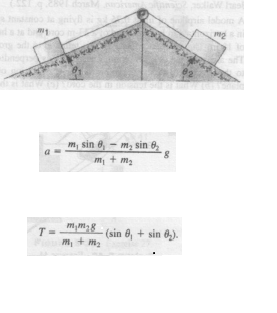
To analyze the system you've described, we need to apply Newton's second law of motion and consider the forces acting on each block. Let's break this down step by step to derive the expressions for the acceleration of each block and the tension in the cord connecting them.
Understanding the Forces at Play
We have two blocks: one on an inclined plane (mass m1) and another on a different inclined plane (mass m2). Both planes are frictionless, which simplifies our calculations significantly. The angles of inclination are θ1 for m1 and θ2 for m2. The forces acting on each block are due to gravity and the tension in the cord.
For Block m1
For the block on the inclined plane (m1), the force due to gravity can be resolved into two components: one parallel to the incline and one perpendicular to it. The parallel component, which causes m1 to accelerate down the incline, is given by:
- Force parallel to incline: F1 = m1 * g * sin(θ1)
According to Newton's second law, the net force acting on m1 is equal to its mass times its acceleration (a). Therefore, we can write:
- Net force on m1: F_net1 = m1 * g * sin(θ1) - T
- Where T is the tension in the cord.
This gives us the equation:
- m1 * a = m1 * g * sin(θ1) - T
For Block m2
Now, let's consider the block m2 on its inclined plane. Similarly, the force acting on m2 due to gravity can be resolved into components. The parallel component that causes m2 to accelerate up the incline is:
- Force parallel to incline: F2 = m2 * g * sin(θ2)
Applying Newton's second law for m2, we have:
- Net force on m2: F_net2 = T - m2 * g * sin(θ2)
This leads to the equation:
- m2 * a = T - m2 * g * sin(θ2)
Setting Up the System of Equations
Now we have two equations:
- 1. m1 * a = m1 * g * sin(θ1) - T
- 2. m2 * a = T - m2 * g * sin(θ2)
We can solve these equations simultaneously to find the expressions for acceleration (a) and tension (T).
Solving for Acceleration
First, let's isolate T in both equations:
- From equation 1: T = m1 * g * sin(θ1) - m1 * a
- From equation 2: T = m2 * g * sin(θ2) + m2 * a
Setting these two expressions for T equal to each other gives:
- m1 * g * sin(θ1) - m1 * a = m2 * g * sin(θ2) + m2 * a
Rearranging this equation leads to:
- (m1 + m2) * a = m1 * g * sin(θ1) - m2 * g * sin(θ2)
Thus, the acceleration a can be expressed as:
- a = (m1 * g * sin(θ1) - m2 * g * sin(θ2)) / (m1 + m2)
Finding the Tension
Now that we have the acceleration, we can substitute this value back into one of our equations to find the tension T. Using the first equation:
- T = m1 * g * sin(θ1) - m1 * a
Substituting for a gives:
- T = m1 * g * sin(θ1) - m1 * ((m1 * g * sin(θ1) - m2 * g * sin(θ2)) / (m1 + m2))
After simplifying, we can find the expression for T. This process illustrates how the forces interact in a system of connected masses on inclined planes.
Final Thoughts
By applying Newton's laws and understanding the forces acting on each block, we derived the expressions for both acceleration and tension. This approach not only helps in solving this specific problem but also builds a foundation for analyzing more complex systems in physics.