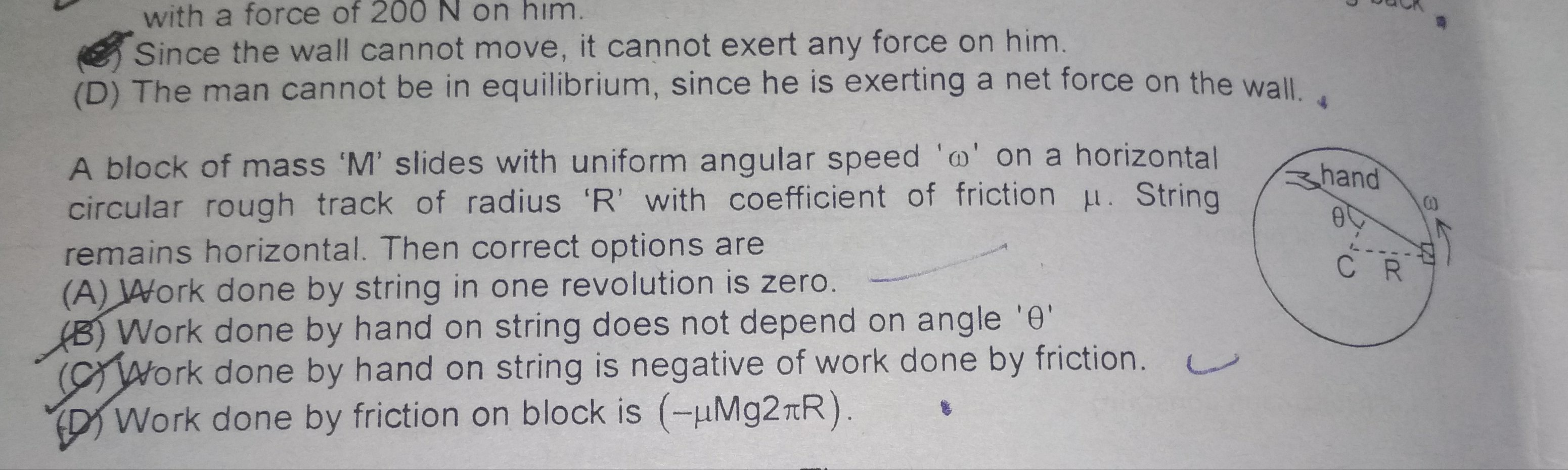
To analyze the situation where a block of mass \( M \) slides with uniform angular speed \( \Omega \) on a horizontal circular track of radius \( R \), we need to consider the forces acting on the block and how they relate to the motion. The coefficient of friction \( \mu \) plays a crucial role in determining whether the block can maintain its circular motion without slipping.
Understanding the Forces at Play
When the block is sliding in a circular path, two primary forces are acting on it:
- Centripetal Force: This is the force required to keep the block moving in a circular path. It is directed towards the center of the circle and is given by the formula:
F_c = M \cdot a_c = M \cdot \frac{v^2}{R}
- Frictional Force: The friction between the block and the track provides the necessary centripetal force to keep the block moving in a circle. The maximum static frictional force can be calculated as:
F_f = \mu \cdot N = \mu \cdot M \cdot g
Relating Angular Speed to Linear Speed
The linear speed \( v \) of the block can be expressed in terms of the angular speed \( \Omega \) as follows:
v = \Omega \cdot R
Setting Up the Equation
For the block to maintain its circular motion without slipping, the frictional force must be equal to or greater than the required centripetal force:
\mu \cdot M \cdot g \geq M \cdot \frac{v^2}{R}
Substituting \( v \) in terms of \( \Omega \):
\mu \cdot M \cdot g \geq M \cdot \frac{(\Omega \cdot R)^2}{R}
After simplifying, we find:
\mu \cdot g \geq \Omega^2 \cdot R
Analyzing the Conditions
This inequality gives us a critical condition for the block's motion. If the coefficient of friction \( \mu \) is sufficient to satisfy this condition, the block will slide without slipping. If it does not, the block will either slide outward or lose contact with the track.
Conclusion on Options
In summary, the correct options regarding the block's motion on the circular track will depend on whether the given values of \( \mu \), \( g \), \( \Omega \), and \( R \) satisfy the derived inequality. If they do, the block can maintain its circular motion; otherwise, it will not. This analysis highlights the importance of friction in circular motion and how it can affect the stability of the system.