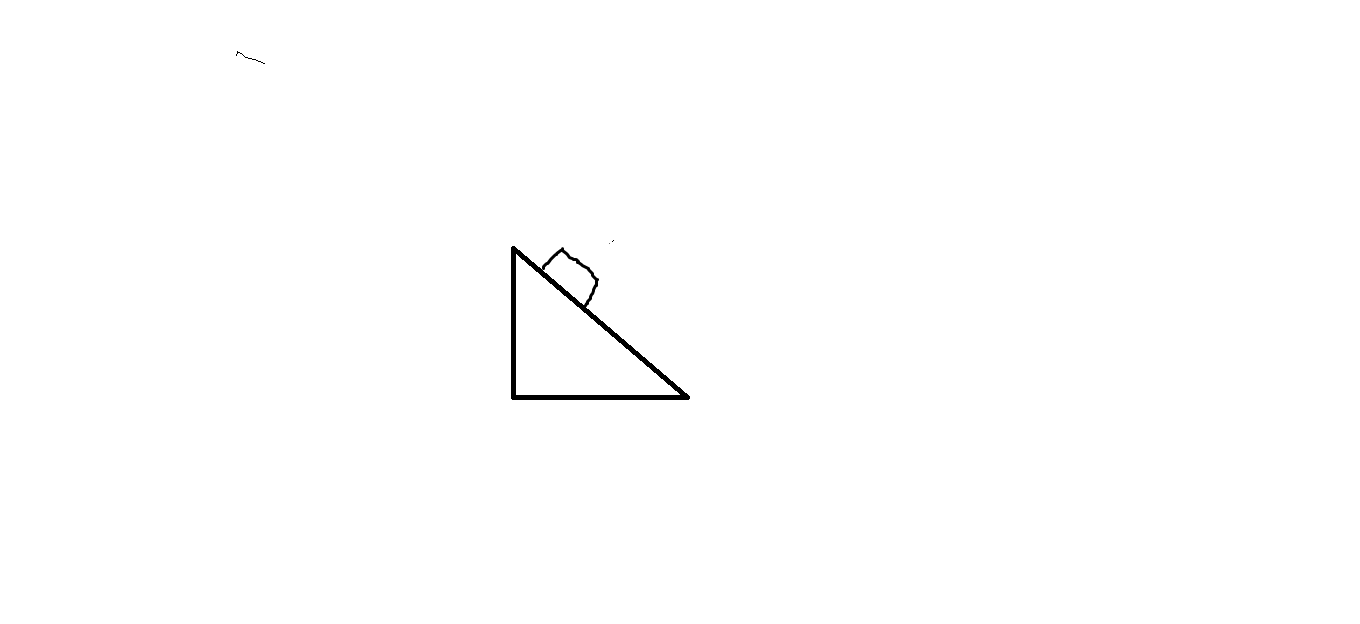
To solve the problem of a block of mass \( m \) placed on a wedge of mass \( 2m \) that rests on a rough horizontal surface, we need to analyze the forces acting on both the block and the wedge. The angle of the incline is given as 45 degrees, and we want to find the minimum coefficient of friction between the wedge and the ground to prevent the wedge from sliding. Let's break this down step by step.
Understanding the Forces at Play
First, let's visualize the scenario. The block is on the inclined surface of the wedge, which is at a 45-degree angle. The weight of the block acts vertically downward, while the normal force from the wedge acts perpendicular to the surface of the wedge. Since there is no friction between the block and the wedge, the only forces acting on the block are its weight and the normal force.
Forces on the Block
The weight of the block can be expressed as:
- Weight of the block, \( W = mg \)
The normal force \( N \) exerted by the wedge on the block can be calculated using trigonometry. Since the angle of the incline is 45 degrees, the normal force can be expressed as:
- Normal force, \( N = mg \cos(45^\circ) = \frac{mg}{\sqrt{2}} \)
Additionally, the component of the weight acting parallel to the incline, which tends to slide the block down, is:
- Downward force along the incline, \( F_{\text{down}} = mg \sin(45^\circ) = \frac{mg}{\sqrt{2}} \)
Forces on the Wedge
Now, let’s consider the forces acting on the wedge. The wedge experiences a normal force from the block, which has a horizontal component that can cause the wedge to move. The horizontal component of the normal force is:
- Horizontal component, \( N_{\text{horizontal}} = N \sin(45^\circ) = \frac{mg}{\sqrt{2}} \cdot \frac{1}{\sqrt{2}} = \frac{mg}{2} \)
For the wedge to remain stationary, the frictional force between the wedge and the ground must be equal to or greater than this horizontal component. The maximum static frictional force can be expressed as:
- Frictional force, \( F_{\text{friction}} = \mu_s \cdot (2m)g \)
Setting Up the Inequality
To ensure the wedge does not move, we set up the inequality:
- \( \mu_s \cdot (2m)g \geq \frac{mg}{2} \)
Now, we can simplify this inequality. Dividing both sides by \( mg \) (assuming \( m \neq 0 \)), we get:
- \( \mu_s \cdot 2g \geq \frac{g}{2} \)
Next, we can cancel \( g \) from both sides (assuming \( g \neq 0 \)):
- \( 2\mu_s \geq \frac{1}{2} \)
Dividing both sides by 2 gives us:
- \( \mu_s \geq \frac{1}{4} \)
Final Result
The minimum coefficient of friction required between the wedge and the ground to prevent the wedge from moving is:
This means that for the wedge to remain stationary under the influence of the block, the coefficient of friction must be at least 0.25. This analysis highlights the balance of forces and the role of friction in maintaining equilibrium in a system involving inclined planes and wedges.