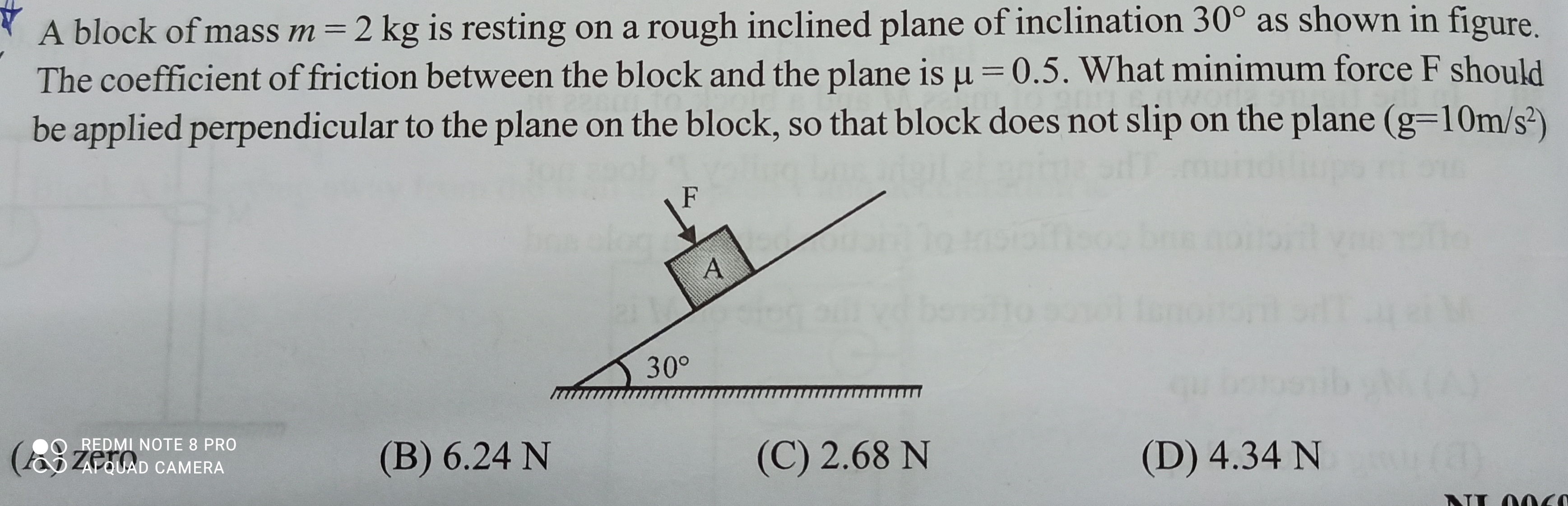
To determine the minimum force that should be applied perpendicular to the inclined plane to prevent the block from slipping, we need to analyze the forces acting on the block. Let's break this down step by step.
Understanding the Forces at Play
When a block is resting on an inclined plane, several forces act on it:
- Weight (W): This acts vertically downward and is calculated as W = mg, where m is the mass and g is the acceleration due to gravity (approximately 9.81 m/s²).
- Normal Force (N): This acts perpendicular to the surface of the inclined plane.
- Frictional Force (f): This opposes the motion of the block and acts parallel to the plane. The maximum static frictional force can be calculated using f = μN, where μ is the coefficient of friction.
- Applied Force (F): This is the force we are trying to find, which acts perpendicular to the plane.
Calculating the Weight Component
First, we need to calculate the weight of the block:
W = mg = 2 kg × 9.81 m/s² = 19.62 N
Next, we can resolve this weight into two components:
- The component parallel to the incline: Wparallel = W sin(θ)
- The component perpendicular to the incline: Wperpendicular = W cos(θ)
For θ = 30°:
- Wparallel = 19.62 N × sin(30°) = 19.62 N × 0.5 = 9.81 N
- Wperpendicular = 19.62 N × cos(30°) = 19.62 N × (√3/2) ≈ 16.97 N
Setting Up the Equilibrium Condition
For the block to remain at rest and not slip down the incline, the frictional force must balance the component of the weight acting down the incline. The normal force is affected by the applied force F:
N = Wperpendicular + F
The maximum static frictional force is given by:
f = μN = μ(Wperpendicular + F)
Setting the frictional force equal to the weight component acting down the incline gives us:
μ(Wperpendicular + F) = Wparallel
Substituting Values
Now, substituting the known values:
0.5(16.97 N + F) = 9.81 N
Expanding this equation:
8.485 N + 0.5F = 9.81 N
Now, isolate F:
0.5F = 9.81 N - 8.485 N
0.5F = 1.325 N
F = 2.65 N
Final Result
The minimum force that should be applied perpendicular to the inclined plane to prevent the block from slipping is approximately 2.65 N.
This analysis shows how forces interact on an inclined plane and how friction plays a crucial role in maintaining equilibrium. If you have any further questions or need clarification on any part of this process, feel free to ask!