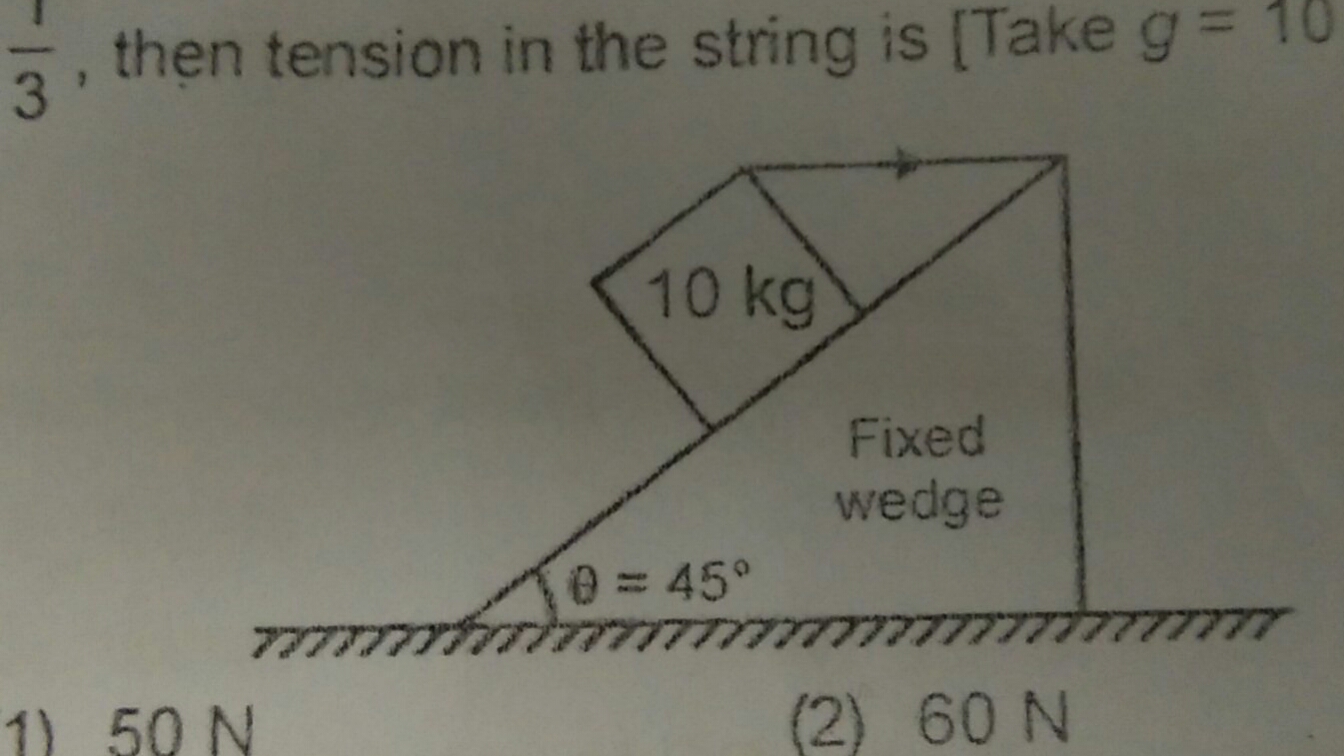
To find the tension in the string for a block resting on a rough inclined plane, we need to analyze the forces acting on the block. Let's break this down step by step.
Understanding the Forces at Play
First, we have a block of mass 10 kg on an inclined plane with an angle of 45°. The forces acting on the block include:
- The gravitational force (weight) acting downwards.
- The normal force acting perpendicular to the surface of the incline.
- The frictional force opposing the motion.
- The tension in the string acting horizontally.
Calculating the Gravitational Force
The weight of the block can be calculated using the formula:
Weight (W) = mass (m) × gravitational acceleration (g)
Here, g is approximately 9.81 m/s². So:
W = 10 kg × 9.81 m/s² = 98.1 N
Resolving Forces on the Incline
Next, we need to resolve this weight into two components: one parallel to the incline and one perpendicular to it.
- The component of weight parallel to the incline (W_parallel) is given by:
W_parallel = W × sin(θ)
For θ = 45°:
W_parallel = 98.1 N × sin(45°) = 98.1 N × 0.7071 ≈ 69.3 N
- The component of weight perpendicular to the incline (W_perpendicular) is given by:
W_perpendicular = W × cos(θ)
W_perpendicular = 98.1 N × cos(45°) = 98.1 N × 0.7071 ≈ 69.3 N
Calculating the Normal Force
The normal force (N) acting on the block is equal to the perpendicular component of the weight since there is no vertical motion:
N = W_perpendicular ≈ 69.3 N
Determining the Frictional Force
The frictional force (f) can be calculated using the coefficient of friction (μ) and the normal force:
f = μ × N
Given that μ = 1/3:
f = (1/3) × 69.3 N ≈ 23.1 N
Setting Up the Equation for Tension
Now, we can set up the equation for the forces acting parallel to the incline. The tension (T) in the string will counteract both the component of weight parallel to the incline and the frictional force:
T = W_parallel + f
Substituting the values we calculated:
T = 69.3 N + 23.1 N ≈ 92.4 N
Final Result
Thus, the tension in the string is approximately 92.4 N. This analysis shows how to systematically break down the forces acting on an object on an inclined plane, allowing us to find the tension in the string effectively.