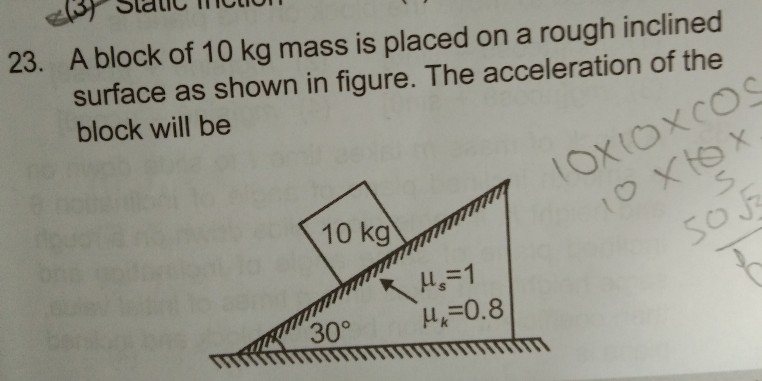
To determine the acceleration of a block with a mass of 10 kg placed on a rough inclined surface, we need to analyze the forces acting on the block. The key factors to consider include the gravitational force, the normal force, the frictional force, and the angle of the incline. Here’s how we can break it down step by step.
Understanding the Forces Involved
When the block is on an inclined plane, gravity pulls it downward. This gravitational force can be broken into two components: one acting parallel to the incline and another acting perpendicular to it.
1. Gravitational Force Components
The weight of the block (W) is given by the formula:
W = m × g
Where:
- m is the mass (10 kg)
- g is the acceleration due to gravity (approximately 9.81 m/s²)
So, the weight of the block is:
W = 10 kg × 9.81 m/s² = 98.1 N
2. Components of Weight
The weight can be split into two components based on the angle of incline (θ):
- The component parallel to the incline: W_parallel = W × sin(θ)
- The component perpendicular to the incline: W_perpendicular = W × cos(θ)
3. Normal Force
The normal force (N) acts perpendicular to the surface and is equal to the perpendicular component of the weight when there’s no vertical motion:
N = W_perpendicular = W × cos(θ)
4. Frictional Force
If the surface is rough, friction will oppose the motion of the block. The frictional force (F_friction) can be calculated using:
F_friction = μ × N
Where:
- μ is the coefficient of friction.
Setting Up the Equation of Motion
Using Newton's second law, the net force acting on the block along the incline can be expressed as:
F_net = W_parallel - F_friction
Hence, we get:
m × a = W_parallel - F_friction
Where a is the acceleration of the block. Rearranging gives:
a = (W_parallel - F_friction) / m
Calculating Acceleration
Let’s say the angle of inclination is θ degrees and the coefficient of friction is μ. Plugging in the values we discussed:
- W_parallel = 98.1 N × sin(θ)
- N = 98.1 N × cos(θ)
- F_friction = μ × (98.1 N × cos(θ))
Finally, substitute these into the acceleration equation:
a = (98.1 N × sin(θ) - μ × (98.1 N × cos(θ))) / 10 kg
Example Calculation
For instance, if the incline angle θ is 30 degrees and the coefficient of friction μ is 0.2, we can calculate:
- W_parallel = 98.1 N × sin(30°) = 49.05 N
- N = 98.1 N × cos(30°) ≈ 84.87 N
- F_friction = 0.2 × 84.87 N ≈ 16.97 N
Now plug these into the acceleration formula:
a = (49.05 N - 16.97 N) / 10 kg = 3.81 m/s²
Thus, the acceleration of the block down the incline would be approximately 3.81 m/s² if the conditions are as stated. Adjust the values based on your specific angle and coefficient of friction for your situation!