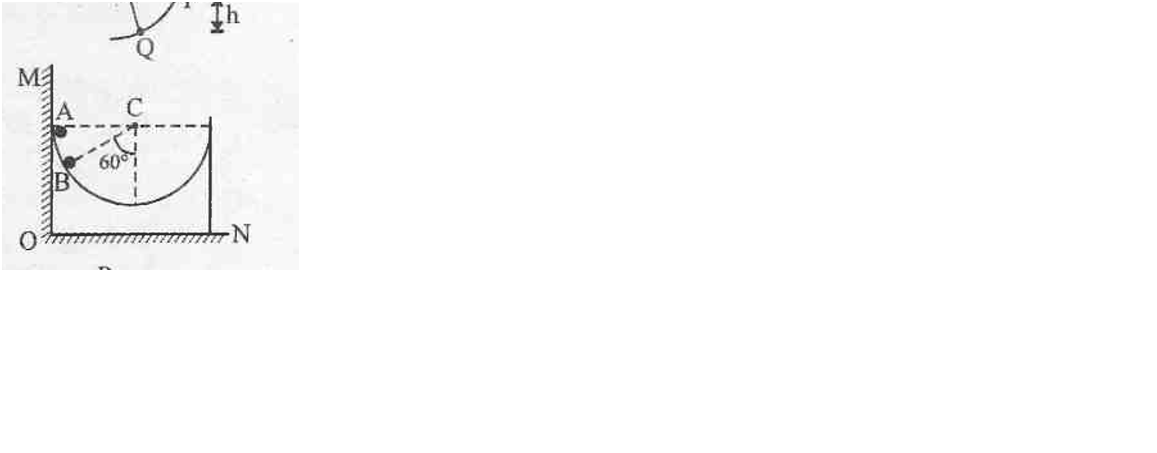
To determine the force exerted by the vertical wall OM on the wedge when the ball is at position B, we need to analyze the forces acting on the ball and the wedge. The scenario involves a ball of mass 1 kg that is released from a height and rolls down the wedge, which has a hemispherical cut. We will apply the principles of dynamics and Newton's laws to find the required force.
Understanding the Forces at Play
When the ball is at position B, it has descended a certain height and is exerting a force on the wedge due to its weight and the acceleration it experiences as it moves along the curved surface. The forces acting on the ball include:
- The gravitational force acting downward, which is equal to \( mg \) (where \( m \) is the mass and \( g \) is the acceleration due to gravity).
- The normal force exerted by the wedge on the ball, which acts perpendicular to the surface of the wedge.
Calculating the Gravitational Force
First, we calculate the gravitational force acting on the ball:
Weight of the ball (W) = mg = 1 \text{ kg} \times 10 \text{ m/s}^2 = 10 \text{ N}
Analyzing the Motion of the Ball
As the ball rolls down the wedge, it will experience centripetal acceleration due to its circular path. The radius of the hemispherical cut is 0.5 m. At position B, the ball is at the bottom of the hemisphere, and we can analyze the forces acting on it.
Applying Newton's Second Law
At position B, the ball is in circular motion, and we can apply Newton's second law in the radial direction. The net force acting on the ball in the radial direction is the difference between the normal force \( N \) and the gravitational force component acting towards the center of the hemisphere.
The gravitational force can be resolved into two components: one acting perpendicular to the surface of the wedge (which contributes to the normal force) and one acting parallel to the surface (which we neglect since we are considering the normal force). The normal force can be expressed as:
N = W + m \cdot a_c
Where \( a_c \) is the centripetal acceleration given by \( a_c = \frac{v^2}{r} \). To find \( v \), we can use energy conservation principles or kinematic equations, but for simplicity, we can assume that the ball reaches the bottom with some velocity \( v \).
Finding the Force on the Wedge
The force exerted by the wall OM on the wedge can be derived from the reaction force due to the normal force acting on the ball. By Newton's third law, the force exerted by the ball on the wedge will be equal and opposite to the force exerted by the wedge on the ball.
Thus, the force \( F \) exerted by the wall OM can be calculated as:
F = N \cdot \sin(\theta)
Where \( \theta \) is the angle of the wedge. Assuming the wedge is symmetrical and the angle is \( 45^\circ \), we find:
F = N \cdot \frac{1}{\sqrt{2}} = \frac{(W + m \cdot a_c)}{\sqrt{2}}
Final Calculation
Assuming the centripetal acceleration is negligible at the bottom (as the ball is momentarily at rest), we can simplify our calculations:
F = \frac{10 \text{ N}}{\sqrt{2}} \approx 7.07 \text{ N}
Thus, the force exerted by the vertical wall OM on the wedge when the ball is in position B is approximately 7.07 N. This analysis demonstrates how forces interact in a dynamic system and highlights the importance of understanding motion and forces in physics.