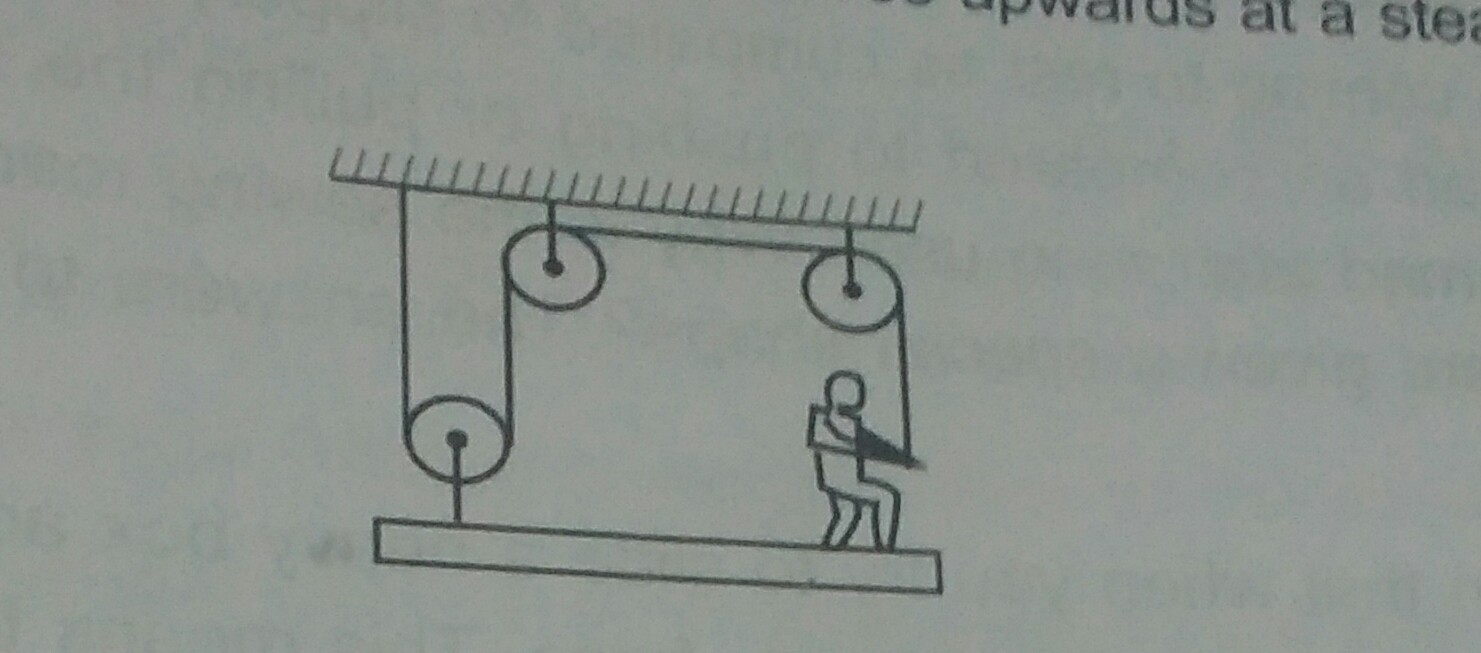
To solve this problem, we need to analyze the forces acting on both the person and the platform. The key here is to understand that the system is in equilibrium, meaning that the forces are balanced, and the platform is moving at a steady rate. This implies that the net force acting on the system is zero.
Understanding the Forces Involved
First, let's identify the weights of the person and the platform:
- Weight of the person (W_person) = mass × gravity = 50 kg × 9.8 m/s² = 490 N
- Weight of the platform (W_platform) = mass × gravity = 25 kg × 9.8 m/s² = 245 N
Next, we can find the total weight of the system:
- Total weight (W_total) = W_person + W_platform = 490 N + 245 N = 735 N
Analyzing the Pulling Force
When the person pulls on the rope, he exerts a force that must counteract the total weight of the system for it to move upwards at a steady rate. Since the system is in equilibrium, the force exerted by the person must equal the total weight of the system divided by two, because the rope goes over the pulleys, effectively distributing the force.
Thus, the force exerted by the person (F_pull) can be calculated as follows:
- F_pull = W_total / 2 = 735 N / 2 = 367.5 N
Evaluating the Options
Now, let's compare this calculated force with the options provided:
- (1) 500 N
- (2) 250 N
- (3) 25 N
- (4) none of these
Since 367.5 N does not match any of the options given, the correct answer is:
None of these
Conclusion
In summary, when the person pulls on the rope attached to the platform, the force required to maintain a steady upward motion is 367.5 N, which is not listed among the provided choices. This illustrates the importance of analyzing forces in systems involving pulleys and weights to understand how they interact.