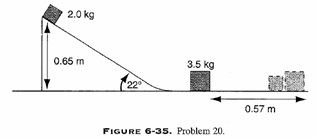
To find the coefficient of friction of the horizontal surface, we need to analyze the motion of the blocks both on the inclined plane and after they collide on the horizontal surface. Let's break this down step by step.
Step 1: Calculate the speed of the 2.0-kg block at the bottom of the incline
First, we can determine the speed of the block just before it collides with the 3.5 kg block. We can use the principle of conservation of energy. The potential energy (PE) at the top of the incline is converted into kinetic energy (KE) at the bottom.
The potential energy at the top is given by:
Where:
- m = 2.0 kg (mass of the block)
- g = 9.81 m/s² (acceleration due to gravity)
- h = 0.65 m (height of the incline)
Calculating the potential energy:
PE = 2.0 kg * 9.81 m/s² * 0.65 m = 12.77 J
At the bottom of the incline, this potential energy is converted into kinetic energy:
Setting PE equal to KE:
12.77 J = 0.5 * 2.0 kg * v²
Solving for v:
- 12.77 J = 1.0 kg * v²
- v² = 12.77 m²/s²
- v = √12.77 ≈ 3.57 m/s
Step 2: Determine the combined mass after the collision
After the collision, the two blocks stick together. The total mass (M) is:
- M = 2.0 kg + 3.5 kg = 5.5 kg
Step 3: Calculate the deceleration on the horizontal surface
Next, we need to find the deceleration of the blocks as they slide across the horizontal surface. We can use the kinematic equation:
Where:
- v = final velocity (0 m/s, since they come to rest)
- u = initial velocity (3.57 m/s)
- a = acceleration (deceleration in this case)
- s = distance (0.57 m)
Plugging in the values:
0 = (3.57 m/s)² + 2a(0.57 m)
0 = 12.76 + 1.14a
1.14a = -12.76
a = -12.76 / 1.14 ≈ -11.19 m/s²
Step 4: Relate deceleration to friction and find the coefficient
The deceleration is caused by the frictional force. The frictional force (F_friction) can be expressed as:
Where:
- μ = coefficient of friction
- N = normal force (equal to the weight of the blocks on the horizontal surface)
The normal force (N) is given by:
N = Mg = 5.5 kg * 9.81 m/s² = 53.91 N
Using Newton's second law, the net force (which is the frictional force in this case) is also equal to:
Substituting for F_net:
μN = Ma
μ(53.91 N) = 5.5 kg * (-11.19 m/s²)
μ(53.91) = -61.54
μ = -61.54 / 53.91 ≈ 1.14
Final Thoughts
The coefficient of friction of the horizontal surface is approximately 1.14. This value indicates a very high level of friction, which is unusual for typical surfaces, suggesting that either the surface is exceptionally rough or there may be additional factors at play in a real-world scenario.