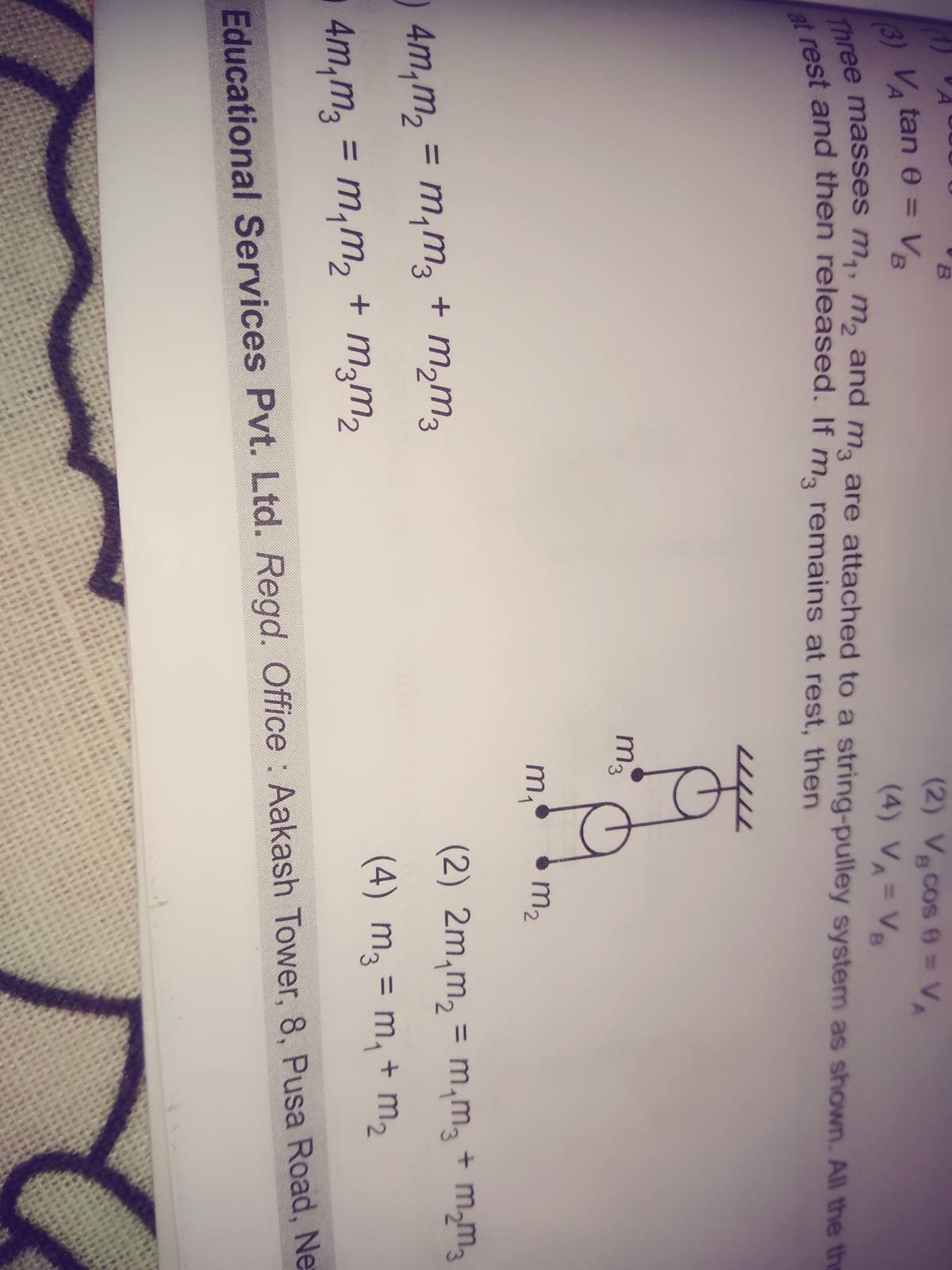
When analyzing a system of masses connected by a pulley, it's essential to consider the forces acting on each mass and how they interact with one another. In your scenario, we have three masses, and if m3 remains at rest after being released, we can infer some important details about the other masses and the system as a whole.
Understanding the Forces at Play
In a typical pulley system with three masses, the forces acting on each mass include gravitational force and tension in the string. Let's denote the masses as m1, m2, and m3, where m3 is the mass that remains at rest. The gravitational force acting on each mass can be calculated using the formula:
- Weight (W) = mass (m) × gravitational acceleration (g)
For example, if m1 and m2 are hanging on either side of m3, the weights can be expressed as:
- W1 = m1 × g
- W2 = m2 × g
- W3 = m3 × g
Equilibrium Condition
If m3 remains at rest, it indicates that the net force acting on it is zero. This means that the tension in the string must balance the weight of m3. Mathematically, this can be expressed as:
T = W3 = m3 × g
For m3 to stay at rest, the tensions in the string segments connected to m1 and m2 must also be equal, assuming the pulley is frictionless and massless. Therefore, we can set up the following equations:
- T1 = W1 = m1 × g
- T2 = W2 = m2 × g
Analyzing the System
Since T1 and T2 must be equal for m3 to remain stationary, we can conclude:
m1 × g = m2 × g
This simplifies to:
m1 = m2
Thus, if m3 is at rest, it implies that the masses m1 and m2 must be equal. If they are not equal, m3 would experience a net force causing it to accelerate either upwards or downwards, depending on which mass is heavier.
Practical Example
Let’s consider a practical example. Suppose m1 = 5 kg, m2 = 5 kg, and m3 = 10 kg. The weight of m3 would be:
W3 = 10 kg × 9.81 m/s² = 98.1 N
Since m1 and m2 are equal, the tensions on either side of m3 would also be equal, allowing m3 to remain at rest. If m1 were 6 kg and m2 were 4 kg, then:
W1 = 6 kg × 9.81 m/s² = 58.86 N
W2 = 4 kg × 9.81 m/s² = 39.24 N
In this case, the net force would not be zero, and m3 would not remain at rest.
Conclusion
In summary, if m3 remains at rest in a pulley system with three masses, it indicates that the masses m1 and m2 must be equal. This balance of forces is crucial for maintaining equilibrium in the system. Understanding these principles helps in analyzing more complex systems in physics and engineering.