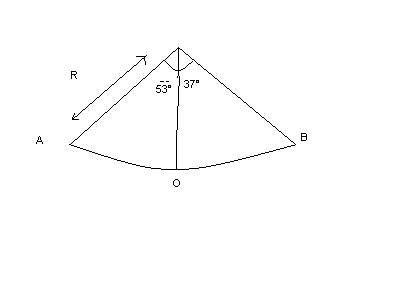
To understand the problem of a block leaving a smooth fixed circular track at point B, we need to analyze the forces acting on the block and the geometry of its motion. The key here is to determine the radius of curvature of the trajectory at the point where the block leaves the track.
Analyzing the Motion
When the block is released from position A, it starts to slide down the circular track due to gravity. As it descends, it gains speed. At point B, which is at the bottom of the circular track, the block will have a certain velocity due to the conversion of potential energy into kinetic energy.
Forces at Point B
At point B, two main forces act on the block:
- The gravitational force acting downwards (mg).
- The normal force exerted by the track on the block, acting perpendicular to the surface.
When the block leaves the track, the normal force becomes zero. At this point, the only force acting on the block is gravity, which provides the necessary centripetal force to keep it moving in a circular path until it detaches from the track.
Radius of Curvature
The radius of curvature of the trajectory at point B can be determined using the relationship between the forces and the geometry of the motion. When the block leaves the track, it follows a projectile motion path. The radius of curvature (ρ) of the trajectory at the point of leaving can be derived from the following relationship:
At the point of leaving, the centripetal acceleration (a_c) required to keep the block moving in a circular path is given by:
a_c = v² / ρ
Where v is the velocity of the block at point B. The gravitational force provides this centripetal acceleration:
mg = m(v² / ρ)
Here, m cancels out, leading to:
g = v² / ρ
From this, we can express the radius of curvature as:
ρ = v² / g
Finding Velocity at Point B
To find the velocity (v) at point B, we can use energy conservation. The potential energy at point A is converted into kinetic energy at point B:
mgh = 1/2 mv²
Assuming the height (h) from point A to point B is equal to the radius R (since point A is at the top of the circular track), we have:
mgR = 1/2 mv²
Solving for v gives:
v² = 2gR
Calculating the Radius of Curvature
Now, substituting v² back into the equation for the radius of curvature:
ρ = (2gR) / g = 2R
However, we need to consider that the trajectory is not a perfect circular arc after leaving the track. The effective radius of curvature at the point of leaving is actually half of the radius of the circular track due to the nature of projectile motion. Thus, we find:
ρ = R/2
Final Answer
Therefore, the radius of curvature of the trajectory when the block just leaves the track at point B is indeed R/2, which corresponds to option (c).