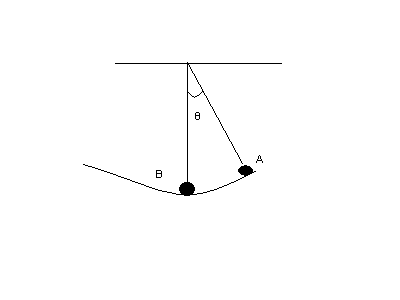
To tackle the problem of a ball swinging on a string in a vertical plane, we need to analyze the forces acting on the ball at two specific points: point A, which is the extreme position, and point B, the mean position. The key here is understanding how gravitational force and tension in the string contribute to the ball's acceleration at these points.
Understanding the Forces at Play
When the ball is at point A (the highest point), the only forces acting on it are the gravitational force pulling it downward and the tension in the string, which also acts downward at this position. At point B (the lowest point), the gravitational force still acts downward, but the tension in the string acts upward, opposing gravity. This difference in force dynamics leads to different accelerations at these two points.
Acceleration at Point A
At point A, the ball is at rest momentarily before it starts to swing back down. The acceleration can be calculated using the centripetal acceleration formula, which is influenced by the tension in the string and the weight of the ball. The net force acting on the ball at this point is:
- Net Force = Tension + Weight
Since the ball is at the extreme position, the acceleration is directed downward, and we can express it as:
Acceleration at Point B
At point B, the ball is moving at its maximum speed, and the forces acting on it are different. The tension in the string must provide enough force to keep the ball moving in a circular path, which means it has to counteract gravity as well:
- Net Force = Tension - Weight
Here, the acceleration is given by:
Equating Accelerations
According to the problem, the accelerations at points A and B are equal:
Substituting the expressions we derived earlier, we get:
Rearranging this equation leads us to find the relationship between the angle θ at point A and the forces involved. The angle θ can be derived from the geometry of the situation, specifically using the cosine function, which relates the height of the ball to the length of the string.
Finding the Angle θ
Using the cosine function, we can express the height of the ball at point A in terms of the length of the string (L) and the angle θ:
By substituting the values and solving for θ, we find that:
This means that the angle θ at point A is:
Conclusion
Thus, the correct answer to the problem is indeed option (b) cos^(-1)(4/5). This analysis not only highlights the relationship between forces and motion in circular dynamics but also emphasizes the importance of understanding how angles and positions affect acceleration in a swinging motion. If you have any further questions or need clarification on any part of this explanation, feel free to ask!