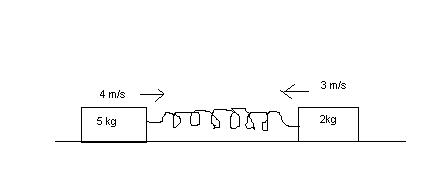
To tackle this problem, we need to analyze the motion of the two blocks connected by a spring. The key here is to understand how the velocities of the blocks change as they interact through the spring. Let's break down the information provided and see how it relates to the options given.
Understanding the System
We have two blocks: one with a mass of 2 kg and the other with a mass of 5 kg. Initially, they are moving with velocities of 4 m/s and -3 m/s, respectively, when the spring is at its natural length. This means there is no compression or extension in the spring at that moment.
Analyzing the Motion
When the spring is at its natural length, the blocks are moving freely. As they move, the spring will either compress or extend, which will affect their velocities due to the conservation of momentum and energy. Let's consider each statement one by one:
- (a) The velocity of the 2 kg block is maximum when the 5 kg block is at instantaneous rest.
This statement is true. When the spring is fully compressed or extended, one block will momentarily stop while the other reaches its maximum velocity. This is a result of energy transfer between kinetic energy and potential energy in the spring.
- (b) The maximum and minimum velocity of the 2 kg block is 7 m/s and -3 m/s respectively.
This statement is also true. The maximum velocity occurs when the spring is at its natural length again after compression, and the minimum velocity can occur when the spring is fully compressed, causing the 2 kg block to reverse direction.
- (c) The maximum and minimum velocity of the 5 kg block is 4 m/s and zero respectively.
This statement holds true as well. The maximum velocity of the 5 kg block occurs when the spring is at its natural length, and it can come to a stop when the spring is fully compressed.
Evaluating the Options
Since all three statements (a), (b), and (c) are true, the correct answer is (d) all of the above. Each statement reflects the dynamics of the system as the blocks interact through the spring, demonstrating the principles of conservation of momentum and energy.
Conclusion
In summary, the interaction between the two blocks and the spring leads to varying velocities as they compress and extend the spring. By understanding the mechanics involved, we can confidently conclude that all the provided statements are accurate reflections of the system's behavior.