

Grade 12Mechanics
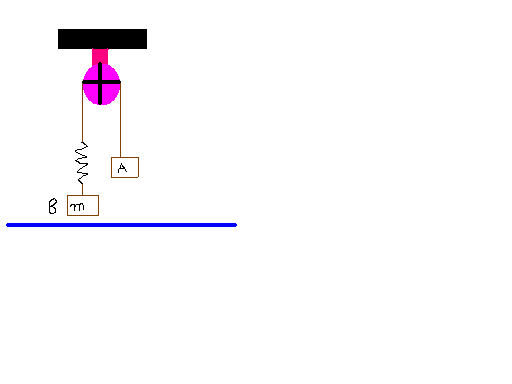
In the figure block A is released frm res when the spring is in it's natural length. For the block B of mass m to leave the contact with the ground at some stage, show that the minimum mass of block A should be m/2.
In the figure block A is released frm res when the spring is in it's natural length. For the block B of mass m to leave the contact with the ground at some stage, show that the minimum mass of block A should be m/2.


 Approved Tutor Answer1 Year ago
To tackle this problem, we need to analyze the forces acting on both blocks A and B, particularly focusing on the conditions under which block B loses contact with the ground. This situation involves concepts from mechanics, particularly Newton's laws and the behavior of springs. Let's break it down step by step.
We have two blocks: block A, which is connected to a spring, and block B, which is resting on the ground. When block A is released from rest, it will start to accelerate downwards due to gravity, causing the spring to stretch. The key point here is to determine the minimum mass of block A required for block B to lose contact with the ground.
For block B to lose contact with the ground, the normal force acting on it must become zero. The forces acting on block B include:
When block A is released, it accelerates downward due to gravity. The spring force will act upwards on block A as it stretches. The spring force can be expressed as \( F_s = kx \), where \( k \) is the spring constant and \( x \) is the extension of the spring.
For block A, applying Newton's second law gives us:
Net Force on Block A:
Let \( M \) be the mass of block A. The equation of motion for block A can be written as:
Mg - kx = Ma
where \( a \) is the acceleration of block A. The acceleration of block A will also affect block B.
For block B to lose contact, we need to consider the forces acting on it at the moment block A is accelerating downwards. The effective force acting on block B can be expressed as:
mg - N = ma_B
where \( a_B \) is the acceleration of block B. For block B to lose contact, we set \( N = 0 \), leading to:
mg = ma_B
Thus, the acceleration of block B must equal \( g \) (the acceleration due to gravity) when block A is accelerating downwards.
Now, we need to relate the accelerations of both blocks. When block A is accelerating downwards, block B will experience an upward acceleration due to the spring force. For block B to just lose contact, the acceleration of block A must be greater than or equal to \( g \). This gives us:
a_A \geq g
Substituting the expression for \( a_A \) from block A's equation, we can derive the relationship between the masses:
From the equation of motion for block A, we can rearrange it to find the minimum mass \( M \) such that:
M \geq \frac{m}{2}
Thus, for block B to lose contact with the ground, the minimum mass of block A must be at least half the mass of block B, or \( M = \frac{m}{2} \). This relationship highlights the balance of forces and accelerations in the system, illustrating how the dynamics of one block directly influence the behavior of another. Understanding these principles is crucial in mechanics, especially in systems involving springs and multiple bodies.

Three identical balls are placed on a frictionless
horizontal surface touching each other. They stick to
each other because of adhesive. Another ball of same
radius and mass m is placed over the void created by
the three balls. Find the forces applied by the balls
kept on the floor to each other if the system remains
in equilibrium.
Last Activity: 10 Months ago
A car loaded with water having total mass 1000 kg moves on a straight horizontal Road starting from rest under the action of a force of 100 Newton. The water spills throw a small hole in the bottom at a rate of 0.1 KG per second the velocity of cart after 300 seconds is nearly.
11
21
31
41
Last Activity: 10 Months ago
Last Activity: 3 Years ago
Last Activity: 3 Years ago